
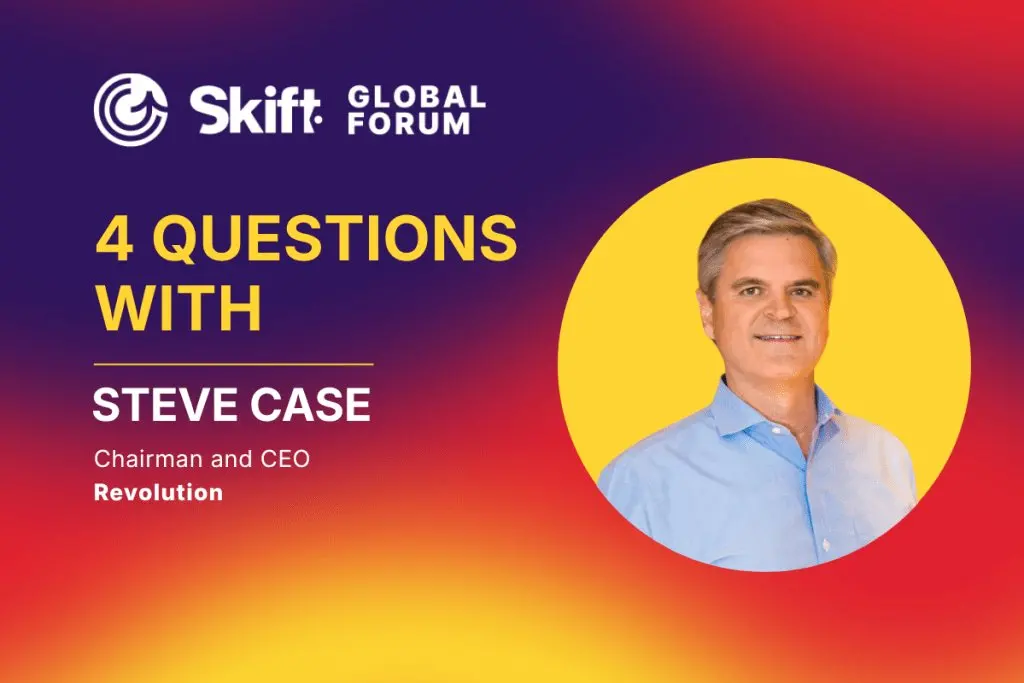
AOL co-founder Steve Case now spends his time — and money — on a simple test for the AI era: will this become abundant, or stay scarce? Ahead of his appearance at Skift Global Forum in New York (September 22–24, 2026), he laid out what that means for travel, and it's a surprisingly reassuring read for anyone worried algorithms will flatten their next holiday.
His logic, which he calls the Scarcity Shift: AI will make information, planning and logistics dirt cheap and endlessly available. So the value moves to what AI can never mass-produce — irreplaceable places, genuine community, earned trust. That's why his company poured into Punta Cacique, an oceanfront peninsula on Costa Rica's Guanacaste coast, plus land in Hawaii and the membership club Exclusive Resorts. No software can conjure a second peninsula.
The data backs him up. In a recent Chase Travel survey of over 4,000 travellers, 60% of Gen Z and Millennials said they want a travel advisor — the most digitally connected generation in history choosing human judgment for the big decisions. Case's read: AI is great at research and admin, but infinite choice produces decision fatigue, not confidence. People want someone they trust to narrow the options. As he puts it, curation isn't a feature of the product anymore — it increasingly is the product.
His most interesting argument is about friction. Bad friction — security lines, hold music, option overload — deserves to die by automation. Good friction is different: the wrong turn that reveals a neighbourhood, the dish you'd never heard of, a conversation with a local. Those moments need a little uncertainty, and they're what travellers actually remember. His worry is that AI optimising every trip will accidentally sand away the serendipity people are paying for. His model, borrowed from Hawaii, is resort-as-base-camp: comfort at your anchor, then deliberately get off the beaten path.
He also sees loyalty shifting from transactional to compounding — membership models like Exclusive Resorts, Inspirato and onefinestay (now grouped as The Exclusive Collective) win because, by the tenth trip, they know your family's rhythms in a way no algorithm starting cold can match.
Why it matters to travellers: this is a useful filter for planning your own trips. Let AI do the grunt work — fares, itineraries, bookings — but budget time and openness for the unplanned, and lean on human recommendations for the choices that count. The lesson from Punta Cacique applies anywhere: pick a great base, then go get a little lost.
Original source: Skift