Cruise altitude sounds lonely — six miles up, open sky in every direction. In practice, the aircraft nearest to you on a long-haul flight is often startlingly close: just 1,000 feet above or below, which is roughly three times the length of a Boeing 777-300ER.
Between flight levels 290 and 410 (29,000–41,000 feet), where almost all long-haul flying happens, the standard vertical separation under Reduced Vertical Separation Minimum (RVSM) rules is just 1,000 feet — halved from 2,000 feet to squeeze more aircraft into the most fuel-efficient altitudes. Laterally, radar separation runs at five nautical miles en route and as little as three nautical miles near airports. Both are well within visual range on a clear day.
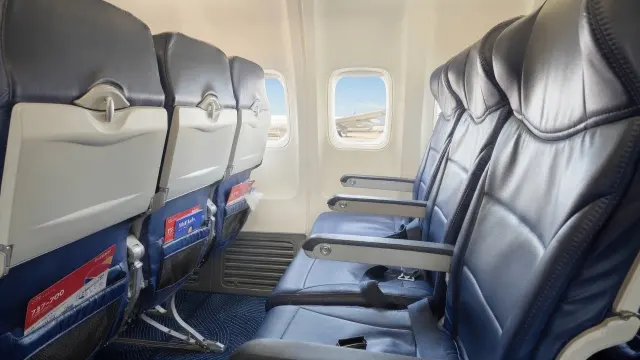
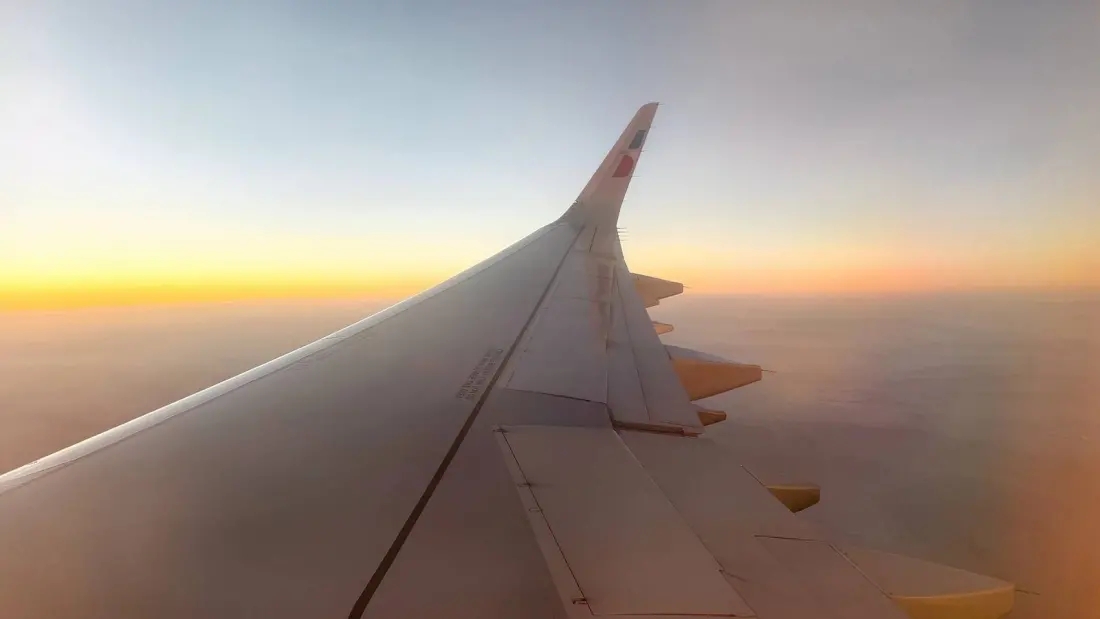
So why don't passengers see anything? The geometry of the window is the culprit. A cabin window sits at shoulder height and faces sideways, so its field of view points out and down. The single most likely position for another aircraft — directly overhead or a level below — is the one place you can't look. The wing blocks much of the below-traffic anyway. Traffic passing sideways does appear, but at combined closing speeds approaching 1,000 knots on opposite headings, it crosses your frame in seconds. Glance down at a screen and you'll miss it entirely.
Conditions matter too. Cloud layers and haze hide distant aircraft, and in daylight a dark airframe against a bright sky is tough to pick out. Night is when sightings spike: navigation lights and anti-collision strobes are visible far beyond the distance at which the aircraft itself would be. That's why passengers on overnight transatlantic and transpacific flights report seeing traffic far more often than daytime flyers.
The tight vertical spacing is a relatively recent development. The North Atlantic adopted the 1,000-foot minimum in March 1997, the Western Hemisphere followed in January 2005, and Africa came on board in September 2008. The payoff was capacity: the same altitude band went from seven usable flight levels to thirteen, letting airlines fly closer to their optimum fuel-burning profiles and making step climbs easier as aircraft lighten mid-flight. Aircraft operating in RVSM airspace need special equipment approval, and their height-keeping performance is monitored continuously.
Want better odds of spotting a neighbour at 35,000 feet? Fly busy corridors where traffic funnels onto parallel routes — oceanic track systems and major continental routes concentrate aircraft predictably. Terminal areas around big airports are the richest hunting ground, with three-mile separation and aircraft stacked at all sorts of altitudes during climb and descent. And book a window seat on a night flight: a strobing light sliding past in the darkness is one of aviation's quieter thrills.
It's worth remembering that a close-looking flypast isn't a sign of trouble — it's the system working as designed, monitored by controllers and TCAS on the flight deck even when nothing is visible from your seat.