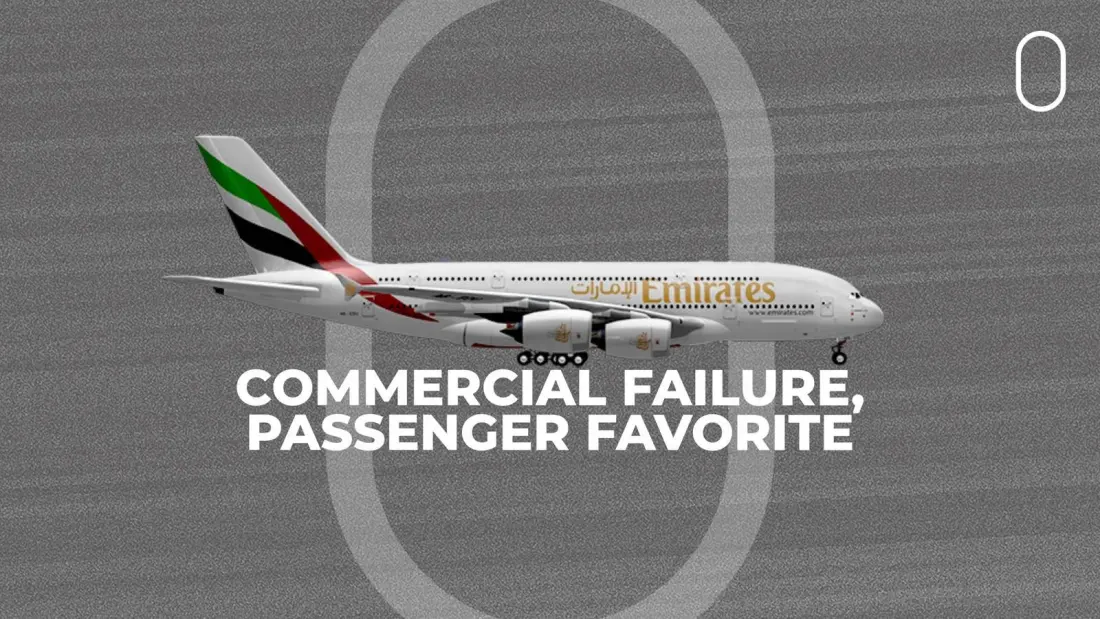
Two decades after it first carried paying passengers, the Airbus A380 remains the most loved aircraft in the sky — even though it never made back the roughly $30 billion Airbus sank into developing it. That's the paradox at the heart of the superjumbo's story.
When it entered commercial service in 2007, the A380 was Airbus' direct answer to Boeing's 747 in the market for huge, long-haul planes. It is still the only commercial airliner with two full-length passenger decks, and that scale is exactly what passengers fell for: roomier cabins, quieter rides, staircases between floors, and in the case of premium cabins on some airlines, bars, showers and suites. No other plane in regular service feels like it.
The business case, though, never held up. The A380 was designed around the idea that passengers would keep hub-hopping between massive airports on full planes. Instead, airlines shifted toward smaller, more fuel-efficient twin-engine jets that could fly point-to-point routes without a stopover. The pandemic then accelerated the retirement of four-engine aircraft across much of the industry. Airbus stopped taking meaningful orders years ago and closed the production line in 2021, having built just over 250 of them.
And yet the aircraft that was supposed to be a financial catastrophe refuses to fade. A handful of airlines kept faith with it — Emirates above all, which operates the type as the backbone of its long-haul fleet from Dubai, alongside operators like Lufthansa, which brought its A380s back after the pandemic. In 2026, these double-deckers are flying fuller and more loved than ever, and aviation fans routinely pick itineraries based on whether an A380 is operating the route.
For travellers, this matters in a very practical way. Flying on an A380 is a genuinely different experience: the upper deck feels like a private jet compared with a standard widebody, economy seats sit further from the engines, and the sheer calm of the cabin makes 12-hour flights easier to survive. Airlines flying the type — Emirates, Singapore Airlines, Qantas, British Airways, Lufthansa and Etihad among them — tend to put their flagship premium products on board, so even a short A380 hop can mean showers at 40,000 feet in first class or a wander up the stairs to the bar.
The lesson of the A380 is a rare happy ending for a commercial failure. The plane lost the boardroom argument but won the passengers. Routes like Dubai to London Heathrow or Singapore to Sydney still regularly see two A380s pass in opposite directions, and airlines keep investing in refurbishing their fleets rather than retiring them. If you've never flown one, there's arguably never been a better time: the aircraft is mature, the cabins are freshly updated, and its days are ultimately numbered, however distant. Book the upper deck if you can — it's the closest commercial flying gets to the golden age of the jumbo jet.