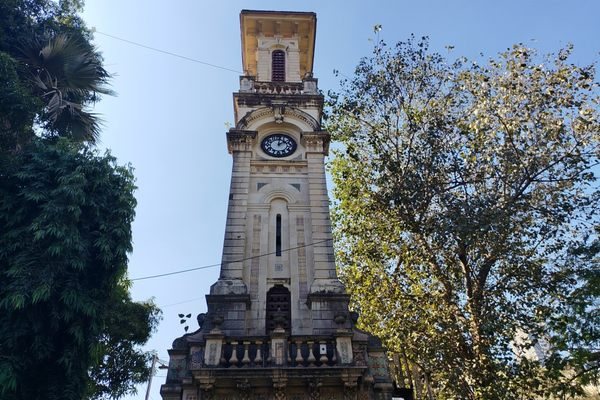
Most visitors rushing into Veermata Jijabai Bhosale Udyan in Byculla walk straight past one of Mumbai's architectural oddities: a slender clock tower rising through the trees at the garden entrance. It is, according to local accounts, the only Palladian-style structure in the entire city — a slice of 19th-century Italianate restraint in a metropolis better known for Gothic Revival rail stations and art deco seafronts.
The tower dates to 1864, when Mumbai was expanding rapidly under British rule. Most of the construction cost was covered by David Sassoon, a Baghdad-born merchant and philanthropist whose family became one of the most influential trading dynasties in colonial Bombay. His name remains attached to the tower, and his legacy is scattered across the city in other buildings and institutions he funded.
The materials tell their own story. The main body was built from Porbandar stone sourced locally — the same kind of masonry found on several landmarks of that era — while sections are dressed with ornamental tiles. A wrought iron staircase clings to one side, more decorative than purely functional by modern standards. It is a small structure, but the detailing rewards anyone who stops for more than a glance.
Its setting is half the appeal. Veermata Jijabai Bhosale Udyan, once called Victoria Gardens, is Mumbai's oldest public garden and zoo, and on any given day the space around the tower is used exactly as it has been for generations: office workers and families dozing in the shade, children running across the lawns, the clock quietly keeping time above it all. There is no ticket booth or queue for the tower itself — it is simply part of the everyday fabric of the neighbourhood, which is precisely what makes it worth seeking out.
Byculla itself has been quietly climbing Mumbai's list of neighbourhoods to explore. The garden and zoo make an easy anchor for a half-day walk, and the area's food scene — old Irani cafés and longtime mill-area eateries among them — pairs well with the history on show. For travellers tired of the Colaba–Gateway circuit, this corner of the city offers colonial-era architecture without the crowds.
Who is this for? If you enjoy architecture that most guidebooks compress into a single sentence, or you like seeing how Mumbaikars actually use their public spaces, the clock tower and its garden make a rewarding detour. Photographers get an elegant stone silhouette framed by greenery, especially in soft morning light, and history-minded visitors can trace the Sassoon family's footprint across the city afterwards. It is a small stop, but a genuinely surprising one — a piece of Palladian design hiding in plain sight, guarded by a clock that has not stopped since the 1860s.
Reported by Atlas Obscura.