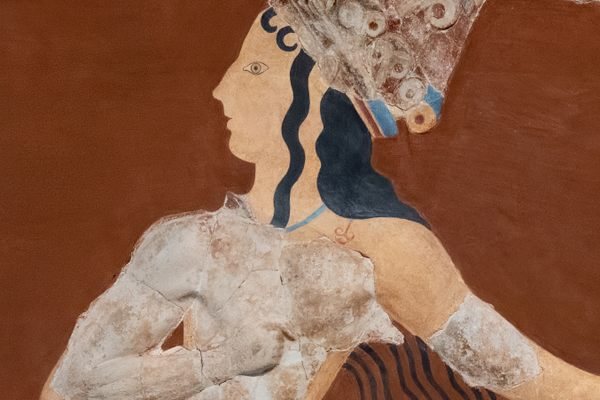
A slim figure crowned with lilies and peacock feathers, mid-stride with a hand raised to his chest: the Prince of the Lilies is everywhere in Crete, from postcards to museum posters, and he's usually billed as a priest-king of Knossos from around 1500 BCE. He may also be, to a large extent, a modern invention.
The fresco was unearthed in fragments during Arthur Evans' excavations at Knossos in the early 1900s. What survived was far less than the finished image suggests: a torso, a crown, and assorted body pieces that might not even belong together. Evans' restorer, Émile Gilliéron, assembled them into a single striding male figure, filling the vast gaps with plaster and a good deal of imagination.
Later scholars have picked the reconstruction apart. Some argue the crown and torso could come from two or even three different figures. Candidates for what the original image actually depicted include a female boxer and a sphinx-like composite creature. In other words, the defining portrait of Minoan royalty may show no such thing.
The controversy is a window into a wider criticism of Evans himself. His rebuilding of Knossos in concrete and vivid paint is often described as invention rather than restoration — a tidy palace-and-king story imposed on a civilization whose real social structure is still poorly understood. The Prince, handsome and confident, is essentially that story rendered in fresco.
Why should this matter to a traveller? Because it changes how you look at two of Crete's headline sights. The reconstructed fresco hangs in the Heraklion Archaeological Museum, and a copy appears on site at the Palace of Knossos, just outside Heraklion. Seeing both is worthwhile — the museum version shows the finished image as most people know it, while Knossos lets you compare it with Evans' other restored frescoes, where the same liberties were taken throughout. For anyone curious not just about ancient ruins but about how archaeology gets made, argued over, and sometimes overreached, this is one of the Mediterranean's most interesting case studies, packaged inside a genuinely great museum visit.
And Crete rewards the detour regardless: Heraklion makes a convenient base for Knossos, the museum is one of Greece's best, and the debate over the Prince is the kind of story that makes the site's jumbled walls feel alive rather than dusty.