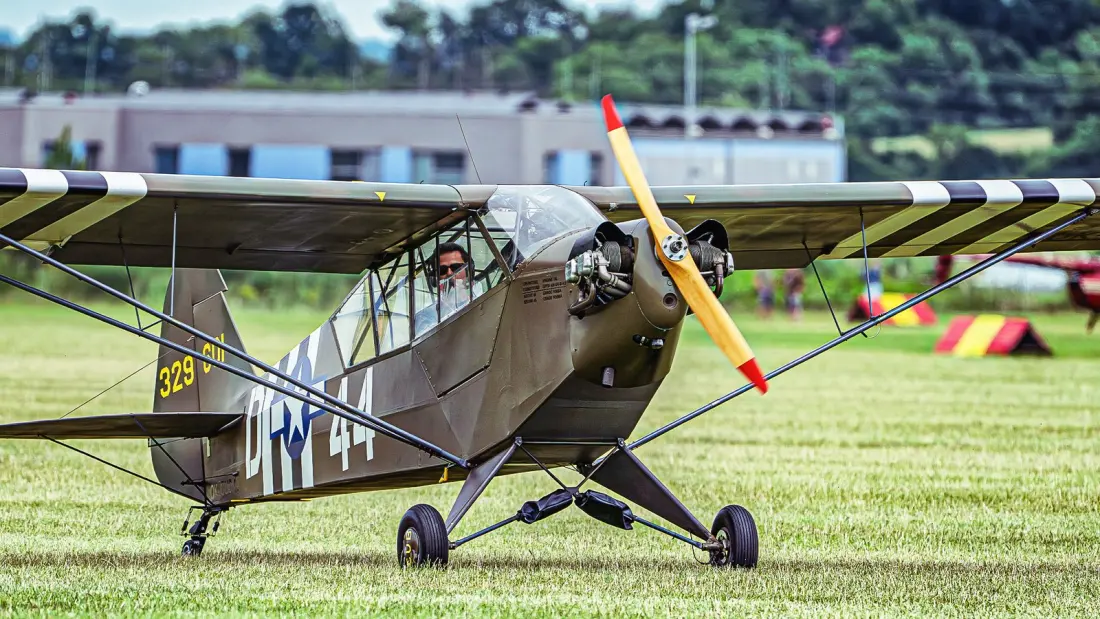
Before the Boeing 707 and the jet age, there was a fabric-covered yellow taildragger that cost about $1,000 and landed at under 40 mph. The Piper J-3 Cub, launched in 1938 from the company's factory in Lock Haven, Pennsylvania, became the machine on which modern aviation was effectively built — and its story is worth knowing for anyone fascinated by how flying went from rich men's stunt to everyday reality.
The numbers are striking. Of the more than 400,000 Americans who flew in WWII, roughly four in five took their first flight in a Cub, and around 75% completed their training in one. At peak production, Piper rolled a finished aircraft out of the door every 20 minutes, and by the time the line wound down in 1947, some 19,000 to 20,000 had been built.
Why did the military bet on it? Forgiveness and cost. With a big wing, light airframe and modest 40-90 hp piston engines, the Cub behaved like a powered glider — students could get things wrong without disaster. The 65 hp Continental version burned just 4-5 gallons an hour, letting flight schools run all day for pennies. In 1941 the Army adopted it as the O-59, later the L-4 Grasshopper, for training, reconnaissance and coastal patrol. Rivals like the Waco UPF-7 and Taylorcraft B could only match a fraction of its market share.
The real legacy came from President Roosevelt's Civilian Pilot Training Program, announced in December 1938, which funded 72 hours of ground school and up to 50 flight hours per student for 20,000 college students a year. Crucially, it opened cockpit doors that had previously been shut: the Tuskegee Institute in Alabama became a major training site, producing the first Black military aviators — the legendary Tuskegee Airmen — while more than 2,500 women learned to fly in the Cub's tandem seats, many going on to serve as WASP ferry pilots.
After 1945, the effects cascaded. Over a thousand regional airfields, control towers and weather stations built for training formed the skeleton of America's air network. Surplus Cubs sold for next to nothing, veterans used the GI Bill to keep flying, and the first modern flight schools and flying clubs appeared at small local strips. By 1944 the pipeline had trained over 435,000 pilots — the talent pool that staffed the first generation of airline cockpits and flew the earliest jets. The checklist-driven, standardized training culture the Cub introduced turned barnstorming-by-feel into the professional discipline jetliners demanded.
For travellers, the Cub still flies. A handful remain airworthy around the world, and aviation museums across the US tell its story — Lock Haven itself preserves Piper's hometown legacy. If you've ever wondered why small-town America has an airport, or why flying feels ordinary rather than daredevil, this unremarkable little yellow plane is largely the answer. — Simple Flying