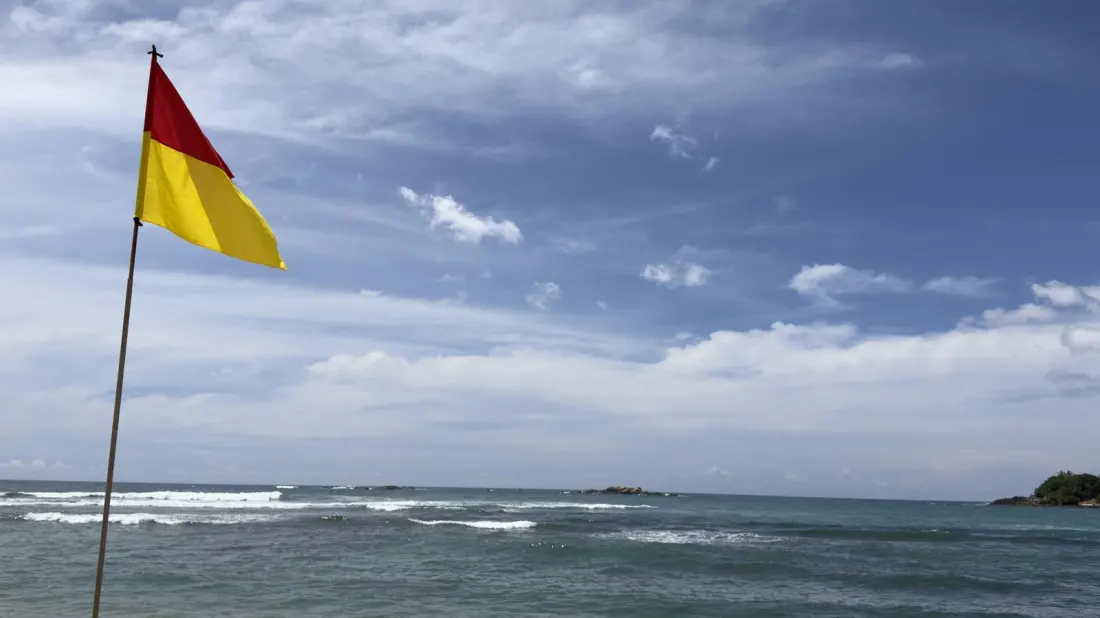
If you've ever scanned a busy beach wondering where the safest patch of water is, the answer is probably flying right in front of you. Under the flag system used by the United States Lifesaving Association, a rectangular flag with a red top half and a yellow bottom half marks the zone where a trained lifeguard is actively supervising swimmers. In other words, it's not a warning — it's an invitation.
That trips people up, because the individual colours carry very different meanings on their own. A solid yellow flag signals moderate risk, while a solid red flag means conditions are dangerous. But the two-colour combination doesn't blend those messages into "kind of dangerous" — it's its own signal entirely, and one worth knowing before your next beach day.
Why does it matter so much? Plenty of popular beaches have no lifeguards at all, and even patrolled beaches aren't watched wall-to-wall. Planting your towel by a lifeguard tower helps, but only when someone's actually on duty — an empty stand offers no protection. The red and yellow flag is the clearest sign that eyes are on the water right where you're swimming. Sometimes these flags come in pairs, with the stretch between them designated as the supervised swim zone. When you see a single flag, stay directly in front of it to remain inside that area.
Conditions can shift fast, though, so the flag isn't a licence to switch off. Keep an ear out for the lifeguard: three blasts on a whistle means everyone should leave the water immediately. It's also worth learning the rest of the USLA flag codes before a trip — the one with a black ball, for instance, means no watercraft in that area.
For families and anyone less confident in the surf, making "swim between the red and yellow flags" a habit is the single easiest safety upgrade you can pack for free. In Australia, Surf Life Saving uses the same convention, so the rule travels well beyond the US too. Check flag status when you arrive, swim inside the marked zone, and you've removed most of the guesswork from a day at the beach.