Standing on the banks of the Magdalena River or in a plaza in Valledupar, you'll hear two very different heartbeats. Cumbia and vallenato both come from Colombia's Caribbean region, and both are woven into the country's identity — but they were born in different places, built from different instruments, and serve different purposes. Knowing the difference makes any trip to the Colombian coast far richer.
Cumbia grew out of the coastal and riverside lands around the Magdalena River, in what are now the departments of Magdalena, Atlántico and Bolívar. It is a genuinely three-way creation: Indigenous communities contributed the gaita flutes, African heritage supplied the drums and percussion patterns, and Spanish influence shaped the dance, clothing and melodic flourishes. Its early form was a collective courtship dance — you can still see women carrying lit candles in traditional performances, moving in circles while men gesture their approach in wide skirts and white shirts.
Vallenato comes from further inland — the old Province of Padilla, spanning today's Cesar, La Guajira and Magdalena departments, with Valledupar as its cultural capital. Where cumbia is dance-first, vallenato was the region's news service. Travelling folk musicians called juglares carried stories, love letters worth of gossip and local events from town to town, which is why vallenato is often called the "sung journalism" of the Caribbean coast.
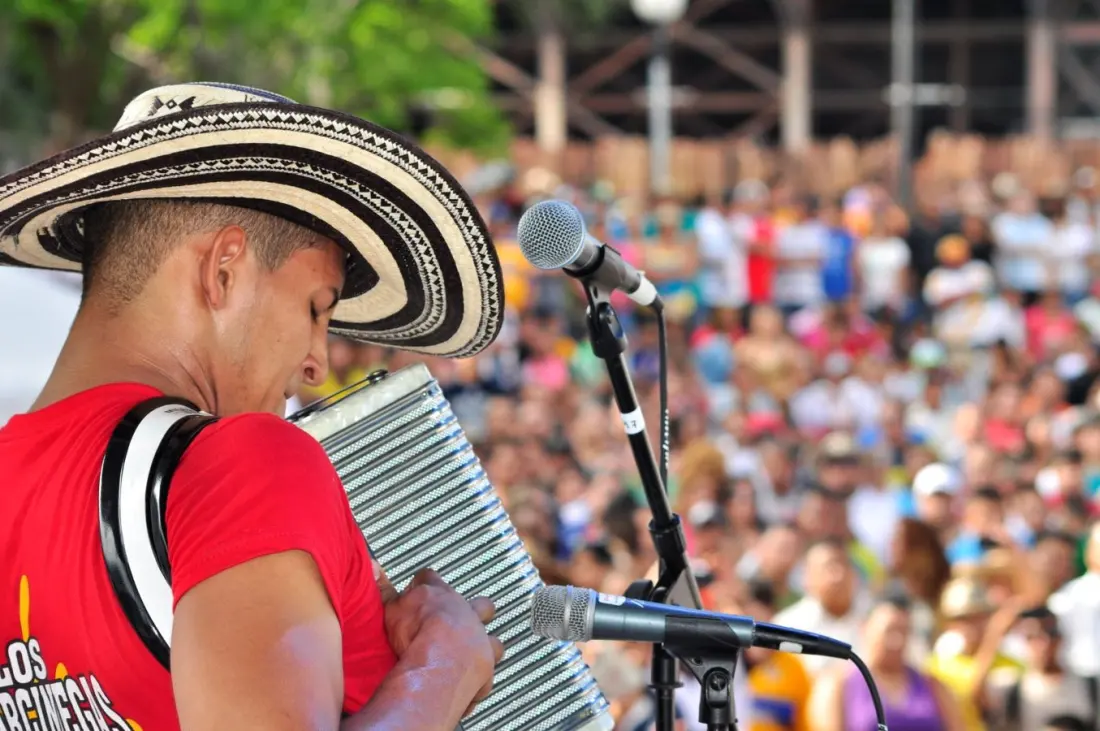
You can tell the genres apart by ear. Cumbia leans on gaitas — the gaita hembra carrying the melody, the gaita macho answering — over three drums (tambor alegre, llamador and tambora) plus maracas. Vallenato is built on a trio of accordion, caja drum and the scraped guacharaca, with the European accordion arriving in the 19th century and becoming the genre's unmistakable voice. Cumbia rolls on a steady, hypnotic groove made for coordinated partner dancing; vallenato runs on four rhythms — paseo, merengue, son and puya — ranging from expressive and slow to the ferociously fast puya that tests any accordion player.
Both have travelled well. Cumbia spread across Latin America, mutating into local styles in Mexico, Argentina, Peru and Chile. Vallenato went global through stars like Diomedes Díaz, Rafael Orozco, Carlos Vives and Silvestre Dangond. UNESCO added traditional vallenato to its Intangible Cultural Heritage list in 2015, flagging the genre as needing urgent safeguarding.
Why it matters for travellers: if you're heading to Cartagena, Barranquilla or Santa Marta, this is the soundtrack you'll be dancing to — and knowing which is which turns a night out into a cultural lesson. Better still, time your trip for the Festival de la Leyenda Vallenata in Valledupar. Running every year since 1968, it gathers the country's best accordion players competing across the four traditional rhythms. It's the single best place to hear the genre as it was meant to be played, in the city that made it famous.