Border signs rarely get ignored, but on the Feistritzer Alm — a high pasture where Austria meets Italy — hikers stroll straight past, cyclists lean their bikes against them and cows graze wherever they fancy. That casual crossing of frontiers is the whole charm of the Alpe Adria, a long-distance trail developed jointly by Austria, Slovenia and Italy, running 750km from the foot of Grossglockner, Austria's highest peak at 3,798m, all the way to the Adriatic.
The full route is a month-long commitment, but there's a smarter option: a 135km loop stitched where the three countries converge. Graded moderate, it takes about a week, with daily walks of 15–24km — think of it as a quieter, cheaper answer to the often-crowded Tour du Mont Blanc.
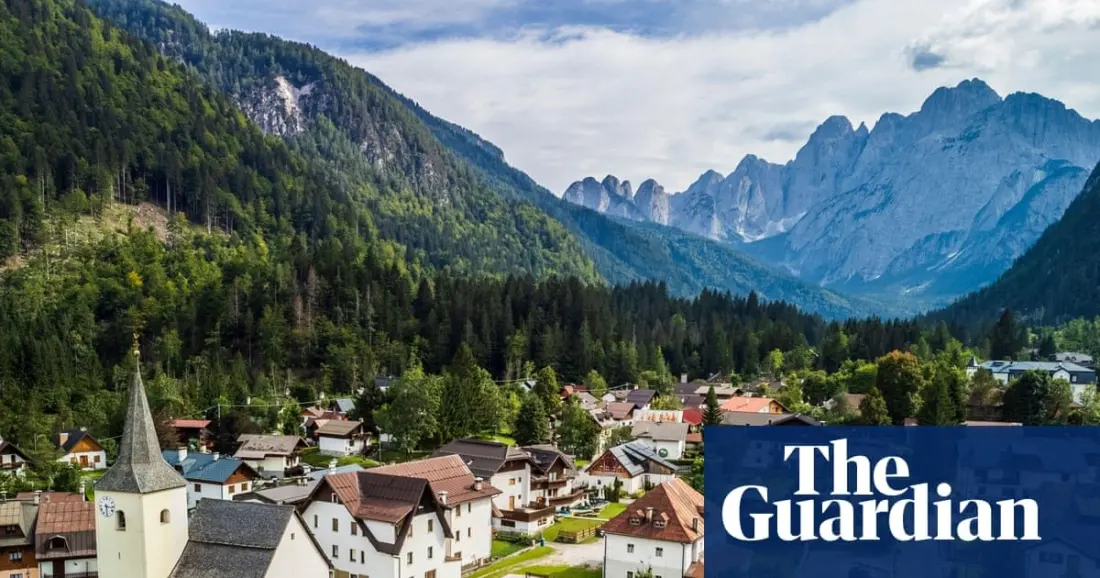
The route delivers a satisfying mix of terrain and small-town Alpine culture. From the Carinthian village of Feistritz, the trail climbs into Italy, dropping to Valbruna — whose inn has a library dedicated to Julius Kugy, the writer-mountaineer who opened up the Julian Alps — then on to the ridge-top pilgrim hamlet of Monte Lussari, where the Virgin Mary allegedly appeared in 1360. Gelaterias await in Tarvisio. Next come the Fusine lakes, twin glacial bowls of an almost implausible blue-green, and a night at Rifugio Zacchi, a 1,380m mountain hut serving venison ragù and frico made with local montasio cheese. Slovenia follows via the Sava Valley to Kranjska Gora, before the final push over the Karavanke Alps and the route's highest point, the 1,842m Schwarzkogel, with views south to Slovenia's peaks and north over Carinthia's lakes.
Getting there can be part of the adventure: the writers travelled by Eurostar to Amsterdam, then an overnight Nightjet sleeper to Salzburg and a final train to Villach — no flights needed.
Practically, it's easy to do yourself. Walks Worldwide runs an eight-day, self-guided Alpe Adria Tri-Country Trek from £895 per person, B&B basis. Anyone can also follow the waymarked trail independently; valley inns and huts make overnight logistics straightforward, though one or two nights sit high in refuges rather than village hotels.
For hikers who like the idea of a multi-country circuit without the crowds or the price tag of the Mont Blanc route, this loop hits the sweet spot: three languages, three cuisines and one set of mountains, all inside a week of walking.