A writer for Condé Nast Traveler just proved you don't need a tent, a car, or even a companion to hike one of England's great trails — just blister plasters and a bus timetable. Her three-day solo route ran from Weymouth to Bournemouth along the South West Coast Path, part of the newly minted King Charles III England Coast Path, a 2,700-mile network the King inaugurated with a walk in March.
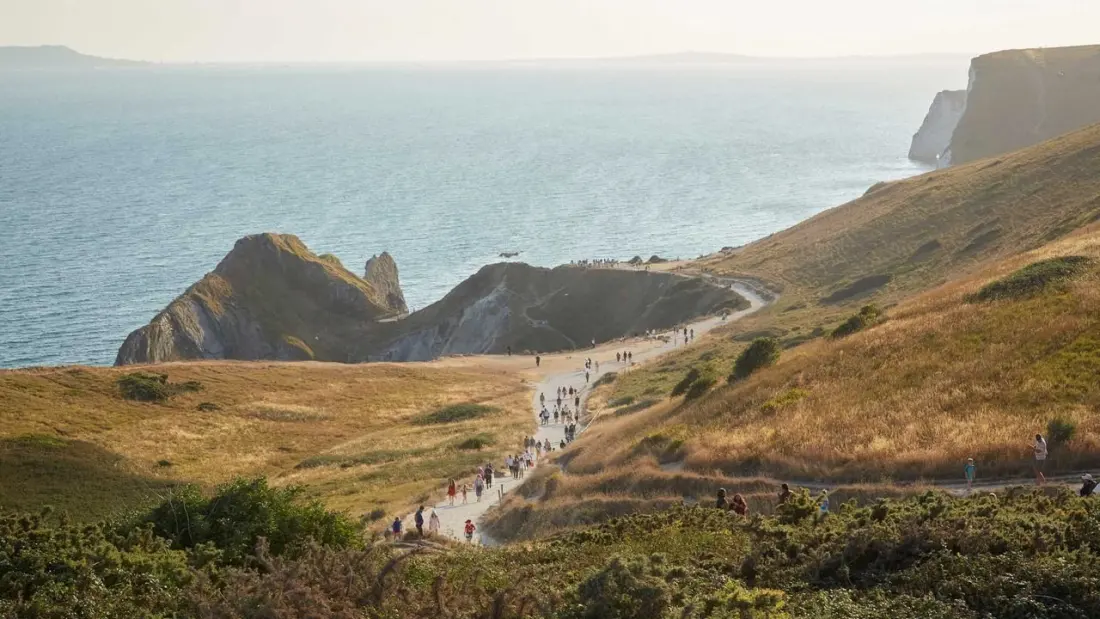
The stretch she chose crosses Dorset's Jurassic Coast, where millions of years of erosion have produced some of the world's oldest fossils and a run of genuinely dramatic geology: the limestone arch of Durdle Door, the almost-enclosed bay of Lulworth Cove (a UNESCO World Heritage Site), the chalk stacks of Old Harry Rocks, and the popular wild-swimming shelf of Danding Ledge. Day one alone involved roughly 12 miles of cliff climbs — 400 feet up, 400 down, on repeat.
What makes this trip so appealing is the logistics. England's coast is dotted with towns, so you walk inn to inn with no camping gear. Phone signal is nearly always available, medical help is close by, and the trail itself is well served by summer public transport — the writer hopped a bus when an Army firing range closed part of her route, and finished with a four-minute ferry across to Bournemouth, where an open-top double-decker called The Breezer drove straight onto the boat. Honestly, that alone sounds worth the trip.
Her itinerary read like a greatest-hits of small-town England: stone cottages in West Lulworth, a B&B night at the Old Barn Inn, a pint at a picnic table in Worth Matravers looking out to sea, and a morning in Swanage before the final stretch along four-mile Studland Beach — which happens to end at the UK's busiest nudist beach, ice cream boat and all. Crowds, notably, were minimal; even the busiest section yielded only a dozen or so walkers.
There was one hiccup worth learning from: directions across farmland are easier given verbally by a friendly B&B owner than followed through a field of sheep. A backup map (and two bars of signal) saved the day.
Why it matters: this is an ideal first long-distance walk for solo travellers who like the outdoors but prefer a locked hotel door at night. No guide required, no heavy pack, and the scenery punches far above the effort.