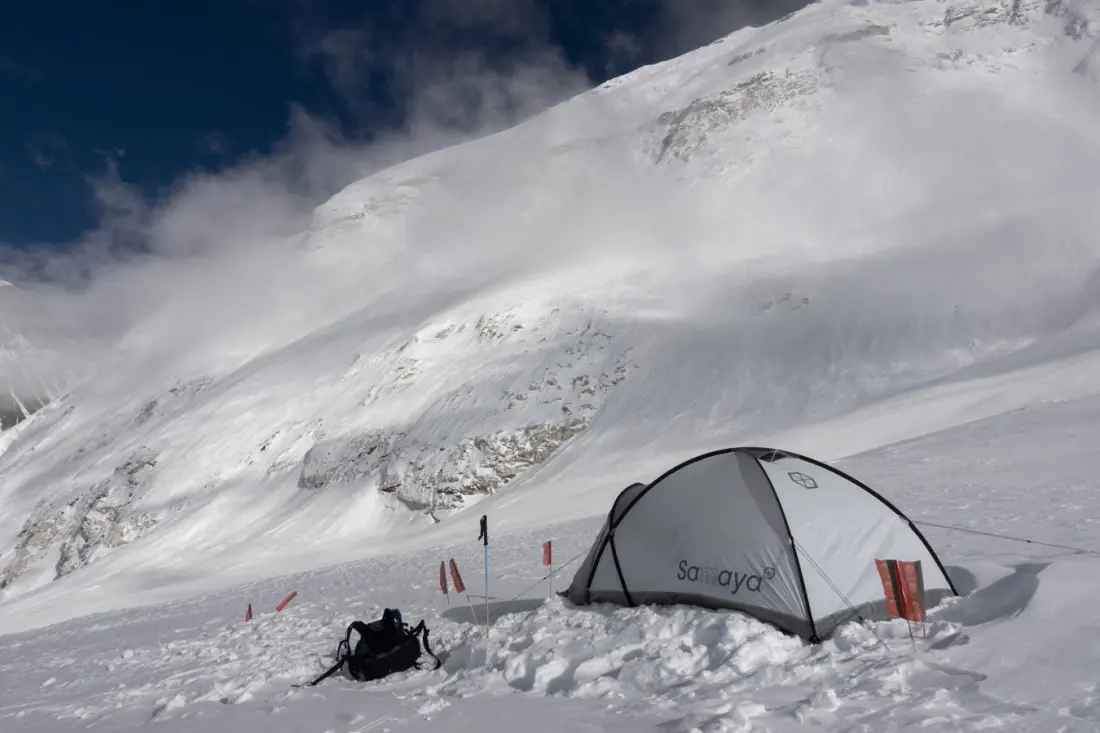
A Russian trio is racing the clock on Everest's West Ridge right now. Andrey Vasiliev, Sergey Kondrashkin and Vitaly Shipilov have started a summit attempt without supplementary oxygen, fully alone on the mountain, with only a few days of calm conditions before violent winds move in.
The odds are stacked against them. Two cyclones have left the upper mountain buried in fresh snow, and with just three climbers, breaking trail above 7,500m is slow, punishing work. On the approach from Base Camp they post-holed up to their waists at times. When their high-altitude boots turned out to be cached two hours ahead, Kondrashkin resorted to duct-taping his pant cuffs to trekking boots to keep snow out, before grinding through a 14-hour push to their Camp 1.
Portuguese high-altitude meteorologist Vitor Baia, speaking to ExplorersWeb, laid out the window clearly: three days of weak wind through Wednesday, with Tuesday the ideal summit day under clear skies. Wednesday remains usable for the descent, but by Thursday the wind swings from west to northwest and ramps up sharply to around 50 kph at 8,000m and 60 kph on the summit. Team leader Vasiliev pegged the window at roughly a week before conditions deteriorate significantly.
Avalanche danger adds another layer of risk. Snow slides swept close to their Camp 1, forcing a day's wait, and the heavy dump from a storm two weeks ago has left slopes unstable. On top of that, Shipilov went down with food poisoning and fever, forcing the team to retreat to their base at Lobuche before deciding, after a single night's rest, to go back up. Kondrashkin's account of the morning decision sums up the group's resolve: when he asked Shipilov at 4am if they were heading up, the answer was simply "We're going."
This is a second attempt. Their October push ended in a tactical retreat when a cyclone hit, though they managed to reach around 7,500m on the West Shoulder, near the start of the West Ridge and the possible detour into the Hornbein Couloir. After recovering in Kathmandu, they returned to Base Camp last Thursday. One frustrating detail for followers: the team is not sharing a live tracker, so their progress is largely a mystery until they report in.
Why care: this is rare late-season, no-Oxygen, low-population climbing on the world's highest peak, a stark contrast to the crowded spring and autumn commercial seasons. If you follow Himalayan mountaineering or are dreaming of your own Everest-region trek, it's a vivid picture of what the mountain looks like when the weather turns and the crowds are gone — deep snow, avalanche zones and a shrinking window of good days. Even trekkers heading to Everest Base Camp or Lobuche in the post-monsoon shoulder season face the same conditions these climbers describe.