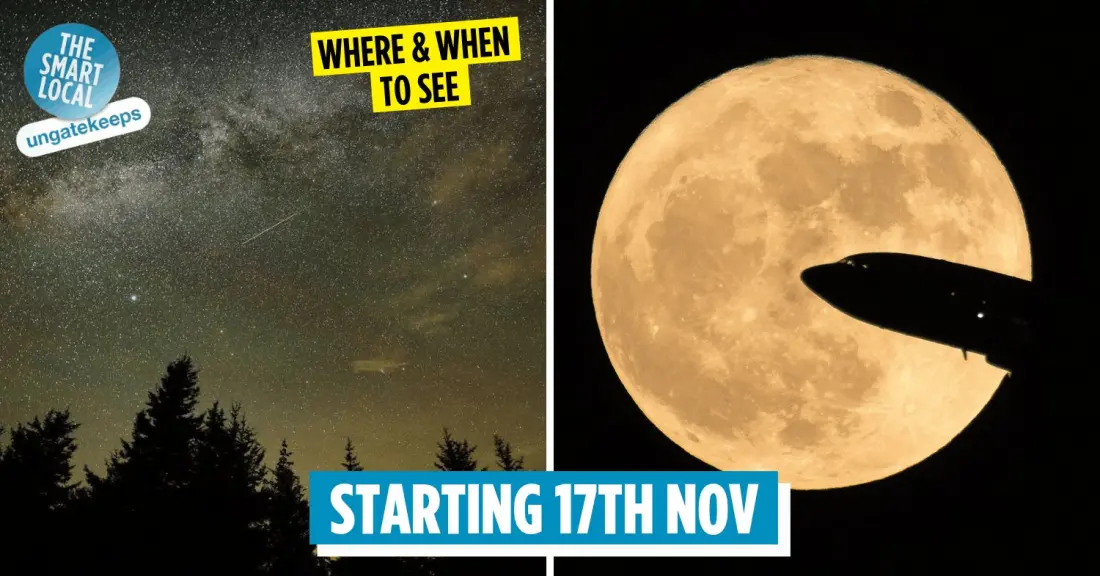
Singapore's night sky has a busy season ahead. The Observatory at Science Centre Singapore has flagged three consecutive supermoons, starting with November's Beaver Moon and running through to January's Wolf Moon, with a couple of celestial extras thrown in for good measure.
First up is the Beaver Moon on 24th November 2026. It rises in the east-northeast at 6.34pm, making it an easy post-dinner watch, and hits full illumination around 10.54pm. December brings the Cold Moon on 23rd-24th, which is the closest and largest supermoon of the year, conveniently timed for Christmas Eve. The finale is the Wolf Moon on 22nd January 2027, full at roughly 8.17pm local time.
A supermoon is simply a full moon that coincides with the moon's closest approach to Earth in its elliptical orbit, a point called perigee. The result looks noticeably bigger and brighter than a regular full moon. They occur about three or four times a year, often in clusters like this one, and funnily enough, 'supermoon' isn't an official astronomy term at all.
If you want more than a bright moon, the calendar has you covered. The Leonid meteor shower peaks on 17th-18th November 2026, with the best viewing window in Singapore between 3am and 5.30am once Leo climbs high enough. The shooting stars are debris from Comet 55P/Tempel-Tuttle hitting the atmosphere at about 71km per second, and under truly dark skies they can hit 15 an hour, though city glow will trim that number. The trick is to go equipment-free: telescopes actually narrow your view, so let your eyes adjust for 20-30 minutes and sweep the whole sky. If you oversleep, the Geminids peak around 13th-14th December.
The night after the Beaver Moon, Uranus reaches opposition on 25th November, meaning Earth sits directly between the Sun and the planet, putting it at its brightest for the year. It rises around sunset in the east and peaks near midnight in Taurus, close to the Pleiades cluster. Realistically you'll want binoculars or a telescope; through a lens it shows as a small greenish disc thanks to methane in its atmosphere. Miss it and the next opposition isn't until 30th November 2027.
The Science Centre Observatory isn't running special sessions for these events, but its regular stargazing programmes continue, typically on the 1st, 2nd and 4th Friday of each month, combining planetarium shows or telescope training with live sky viewing.
For travellers and locals alike, this is a zero-cost evening plan: head to Marina Barrage, East Coast Park or the Southern Ridges for elevated, low-glare views, or really any open spot. A moon this bright is hard to miss anywhere in Singapore, so clouds are your only real rival. If you're visiting during late November or the Christmas period, timing a trip around moonrise costs nothing and delivers one of the best free shows in the city.