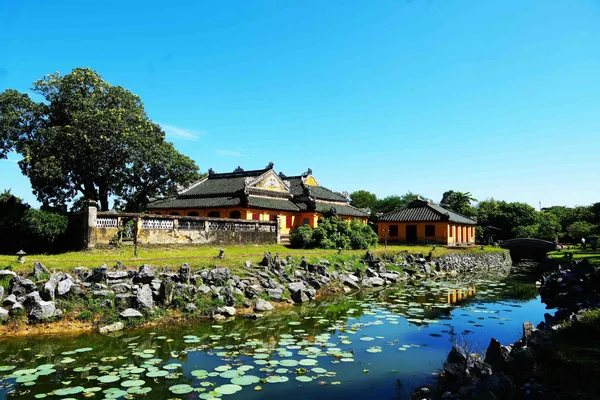
Most visitors to Huế's Imperial Citadel march straight to the throne rooms and courtyards at the centre. Fewer wander to the north-western corner, where one of the complex's most atmospheric structures sits quietly: Trường Sanh Palace, a former royal retreat built in 1821.
Commissioned under Emperor Minh Mạng, the palace was designed not as a seat of power but as a garden refuge for the Nguyễn dynasty's empress dowagers — the mothers and widows of emperors who lived out their later years among lotus ponds and pavilions. Emperor Thiệu Trị rated it so highly he placed it seventh among the twenty finest scenic spots in the old imperial capital. That's high praise from a poet-emperor who had a lot of garden to choose from.
What survives today is a layered ensemble rather than a single building. The main gate, with its carved detailing, sets the tone, backed by a screen wall covered in traditional motifs. Beyond it lie several halls — Ngũ Đại Đồng Đường and Thọ Khang among them — arranged around water features including the Đào Nguyên Canal and Tân Nguyệt Lake, a crescent-shaped pond that gives the grounds much of their calm. The palace was carefully restored between 2005 and 2007, so the woodwork and joinery you see now are the product of that two-year conservation effort.
The appeal is less about spectacle and more about atmosphere. Compared with the busier sections of the Citadel, Trường Sanh tends to be peaceful, and the combination of halls, gates and water makes it a good half-hour or so of slow wandering — especially in the early morning before tour groups arrive, or in late afternoon light when the gardens are at their best.
For travellers, it slots neatly into a day at the Citadel itself, Huế's headline sight and a UNESCO World Heritage Site. Pair it with the nearby royal tombs along the Perfume River, and you get a fuller picture of how the Nguyễn court lived — the formal, ceremonial Huế at the centre, and this softer, garden-side version at the edges. History-minded visitors get the architecture; photographers get reflections, framed gates and quiet corners. It's a rewarding stop for anyone who likes their monuments with a bit of breathing room.
Photo feature by Vietnam News Life.