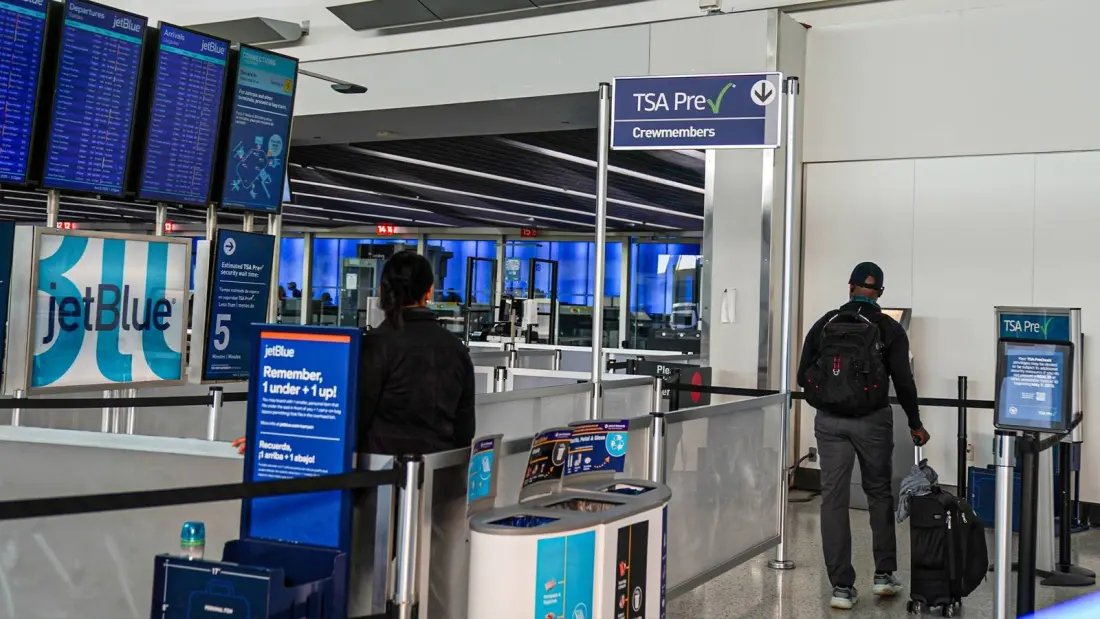
Two paid programmes promise to shave minutes off US airport security, but they fix completely different problems. TSA PreCheck speeds up the physical screening — you typically keep shoes, belts and light jackets on, and leave laptops and compliant liquids in your bag. CLEAR+ attacks the earlier stage: instead of queueing to show your ID to a document checker, a facial-recognition scan verifies who you are. You still go through regular screening afterwards. The two aren't rivals so much as solutions to separate bottlenecks — and you can stack them.
On price, it's not close. PreCheck costs roughly $77–85 and lasts five years, which works out to about $17 a year at the top end. CLEAR+ runs $219 annually; over five years that's around $1,095. PreCheck also travels with you, operating at roughly 200 US airports, while CLEAR+ covers 62. For anyone flying a few times a year — families and leisure travellers especially — PreCheck is the sensible first buy. Children travelling with an enrolled parent may use the lane too, depending on age and reservation details.
CLEAR+ makes sense for a narrower group: frequent flyers whose home airport has chronically slow ID-check lines and working CLEAR lanes at the terminals they use. If the regular document queue is short on a given morning, the $219 buys you very little. The honest way to decide is to look at where your time actually goes — the identity line, or the screening itself.
There's a bundling wrinkle worth knowing. New applicants who enrol in PreCheck through CLEAR's process can pay $85 for five years of PreCheck plus a first year of CLEAR+ at $134 — $219 combined, the same as one standard year of CLEAR+. Online renewals split it as $73 and $146. It's a decent deal if you were already considering CLEAR+, but it doesn't lock in that price: CLEAR+ renews annually at the standard rate, and the two programmes sit on different cycles. Some credit cards and airline loyalty schemes offer CLEAR+ credits, which helps — but only if the card is worth holding anyway.
Two caveats from 2026. First, paid lanes aren't bulletproof: during the March federal shutdown, staffing shortages forced Houston's George Bush Intercontinental to suspend both PreCheck and CLEAR+ at some checkpoints. Second, privacy: CLEAR+ is built on biometric data, so it's worth reading how your face and identity records are stored and used before signing up. PreCheck also requires a background check, but doesn't involve the same biometric service.
The takeaway: buy for your airport habits, not the promise of a shortcut. Occasional flyers should start with PreCheck and skip the annual fee. Road warriors at busy hub airports may find both worth stacking — with the value reassessed each year rather than assumed.