Why does a bride hand over exactly ten betel nuts before leaving her family home? And why should you stay indoors on your second and fourth birthdays, ideally nowhere near a river? A new book by German architect and heritage conservationist Niels Gutschow answers questions most visitors to Kathmandu never think to ask.
Gifts Offerings Sacrifices: The Art and Practice of Ritual Offerings of the Newars in Nepal is the product of nearly six decades of fieldwork. Gutschow first arrived in Nepal in 1962, returned almost every year for heritage projects — including restoration work at Purajimath in Bhaktapur — and lived there until 2021. Published by the Saraf Foundation for Himalayan Traditions and Culture and due out in 2026, it documents the Newar community's rituals with an almost clinical eye, while insisting it should not be read as the final word: the material comes from repeated observation and participation, and traditions are shifting.
The book opens by untangling vocabulary most travellers use interchangeably. A gift is voluntary and unpaid-for. An offering is worship. Sacrifice originally meant making something holy, long before it became tied to animal sacrifice at festivals like Dasain — a chapter the reviewer suggests needs a trigger warning for its graphic images and religious justifications. A Buddhist rituals chapter offers a contrast, renouncing animal sacrifice entirely. There's also dana, selfless donation to those in distress, which the Nepali Times review probes with some scepticism: is a donation really selfless if it earns merit, or a photo with a minister?
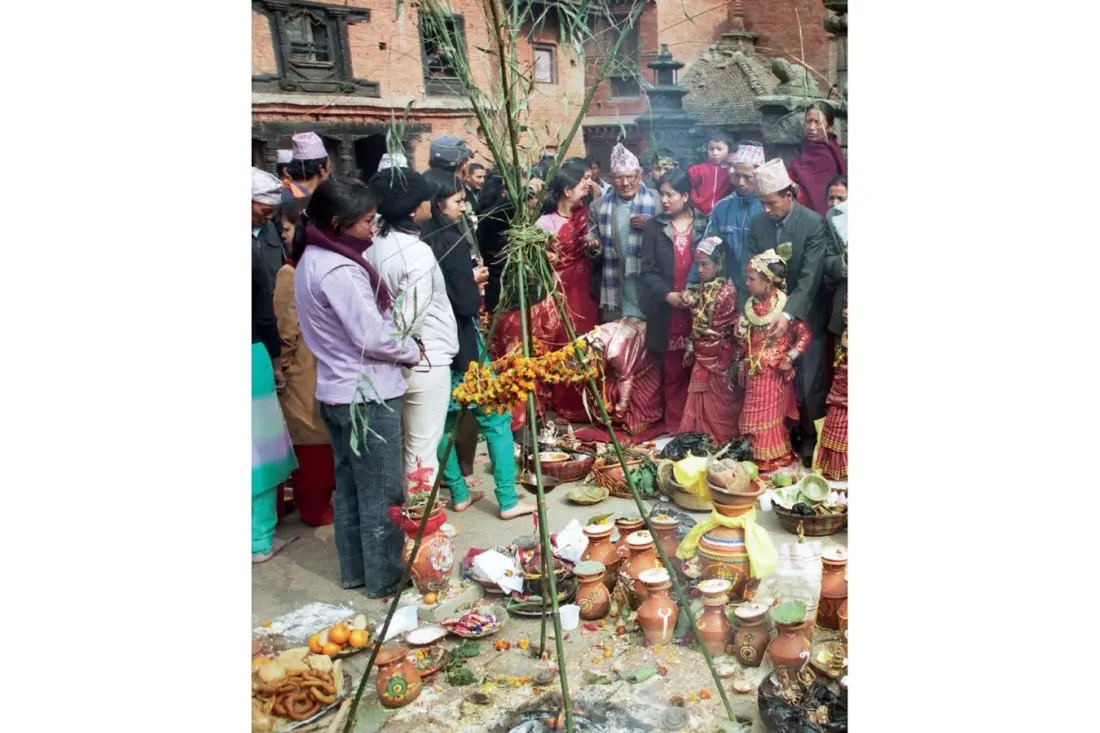
The heart of the book is its three-part structure: urban rituals, life-cycle rituals and domestic rituals. Urban coverage takes in Kathmandu's big spectacles — the Biska chariot festival, Yenyapunhi, Indra Jatra and Saparu. Life-cycle chapters follow a Newar life from Annaprasana (first rice feeding) through Ihi initiation for girls, Kyatapuja for boys, the Barha seclusion of a maiden, and marriage.
The betel nut material is the standout. Native to the Philippines, it turns out to be indispensable in Newar rites: a bride severs ties with her natal home by distributing betel nuts to parents and relatives, and three days after the wedding the matchmaker gives the groom five nuts to pass to his wife's family, confirming his obligations as a 'wife-taker' — support in times of death, in exchange for which his wife acts as the family's unpolluted daughter in funeral rites.
The most cinematic passage describes a centenary ceremony in Bhaktapur, where 100-year-old Chalmaya Shakya climbed into a large painted water pot representing the cosmic womb. Emerging from it signified ritual rebirth — after a symbolic ritual death.
Why it matters for travellers: timing a trip around Indra Jatra or Yomaripunhi is one thing, but understanding what the offerings of rice, citron, betel and buffalo meat actually mean transforms watching into comprehension. This compact, well-produced volume is a genuinely useful companion for anyone spending real time in the Kathmandu Valley — especially those drawn to Bhaktapur's living traditions rather than just its squares.