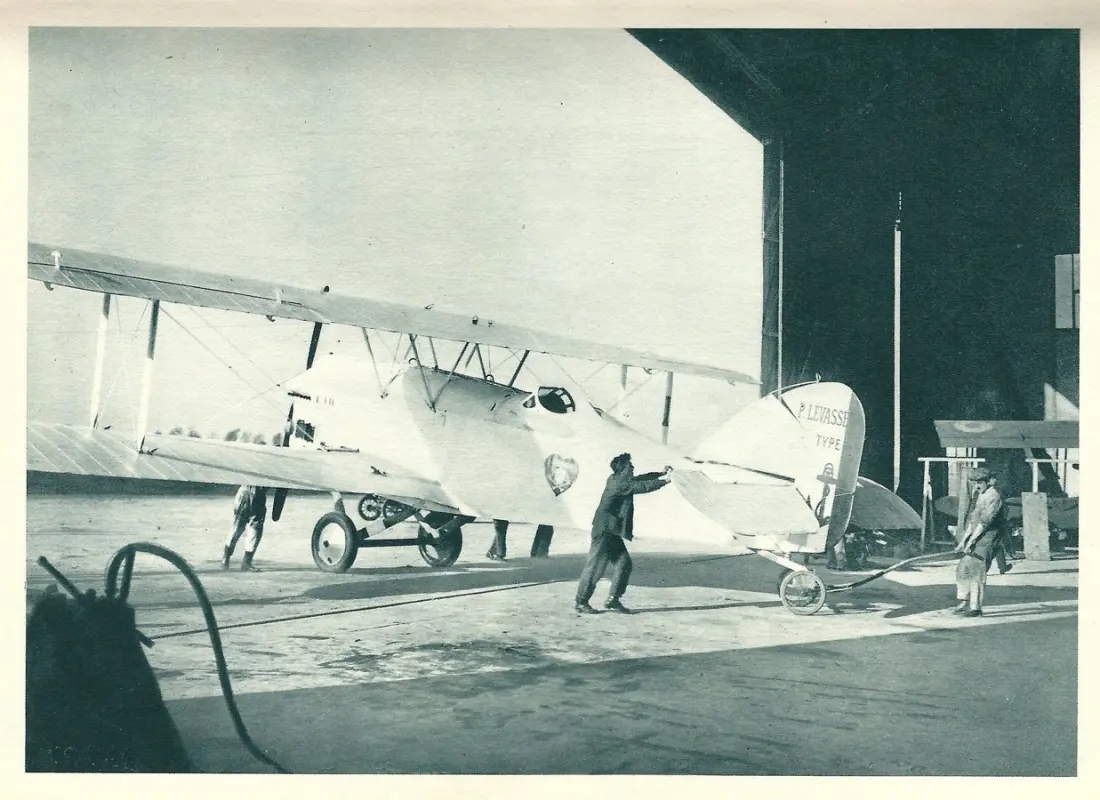
On 8 May 1927, a white biplane dropped its landing gear over the Channel and pointed west at the Atlantic. Thirteen days before Charles Lindbergh made aviation history at Le Bourget, François Coli and Charles Nungesser had taken off from the very same Paris field, flying the harder way — east to west, into the prevailing winds — chasing the $25,000 Orteig Prize for the first nonstop New York–Paris flight. Nobody ever saw them again.
Coli, 45, a decorated war veteran who had been planning the crossing since 1923, paired up with Nungesser, France's third-ranking ace with more than forty kills and a flair for drama — hence the skull, coffin and candles painted inside a black heart on the fuselage. Their aircraft, a Levasseur PL.8 nicknamed L'Oiseau Blanc (the White Bird), carried roughly 4,000 litres of fuel for about forty hours aloft. There was no radio. Navigation was Coli with a sextant and the stars. The fuselage was sealed like a boat hull because the plan was to ditch in New York Harbor; once the wheels fell away, water was the only option.
The sightings stack up eerily. Crowds watched from the cliffs at Étretat in Normandy. A British submarine logged a biplane near the Isle of Wight; witnesses in Dungarvan and near Carrigaholt in Ireland reported a plane overhead. Then, silence — aside from unverified claims of a white aircraft circling in fog over Harbour Grace, Newfoundland. French newspapers briefly celebrated a landing in New York that never happened, before the story collapsed and Paris's joy turned to anger. When forty-two hours passed with no word, searches began: Floyd Bennett flew nine days of patterns, and French, American and Canadian vessels scoured the ocean. Nothing was recovered.
The puzzle still isn't solved. Since 1985, the research group TIGHAR — which calls L'Oiseau Blanc history's most important missing airplane — has chased a lead from hermit Anson Berry, who claimed he heard a plane come down near Round Lake, Maine, directly under the planned route. Twenty expeditions and two hundred volunteers later, no evidence. Searches in Newfoundland's Avalon Peninsula, including dives backed by Clive Cussler's NUMA, also came up empty. Which leaves two possibilities: the aces went into the sea midway, or they actually crossed the Atlantic before Lindbergh's engine ever started — first to conquer it, dying within sight of the finish.
For travellers, the story is written into the French coast. A monument stands on the cliff at Étretat where the White Bird was last seen — the original was torn down during the German occupation in 1942 and replaced by a taller one in 1963. Paris honours the pair with a street in the 16th arrondissement named for both men, and a 1967 commemorative stamp. Étretat's dramatic chalk cliffs make an easy day trip from Le Havre or Rouen, and standing at the memorial where the biplane slid out over the water gives the mystery a physical anchor. Aviation history buffs can pair it with Le Bourget's excellent air and space museum on Paris's northern edge, where Lindbergh landed in the White Bird's shadow.