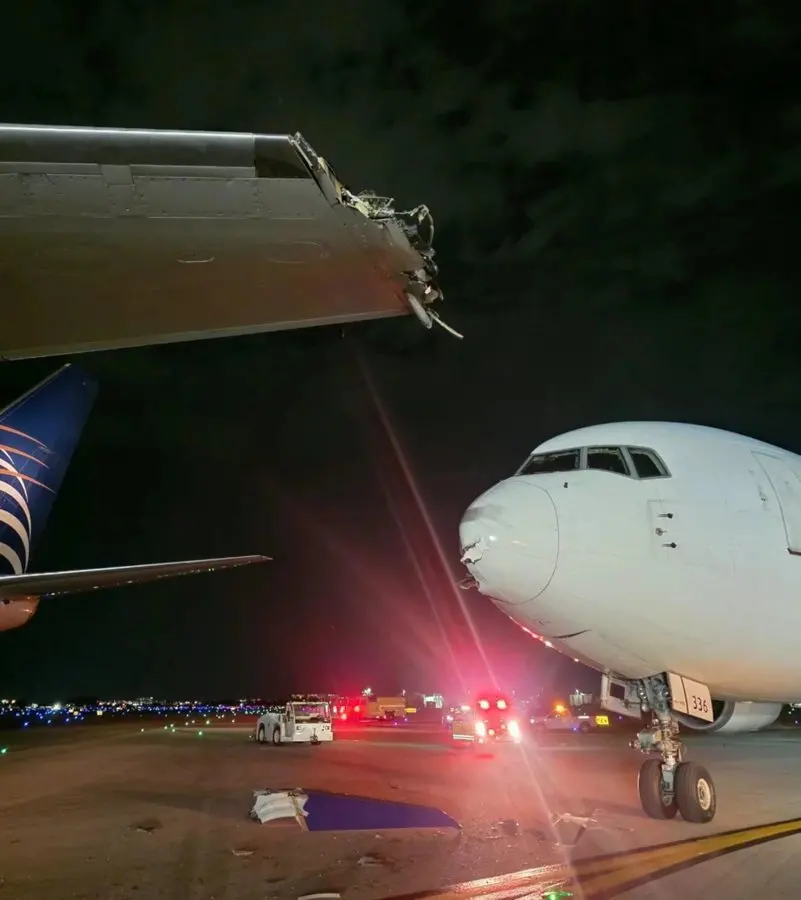
Two large aircraft made contact on the ground at Miami International Airport late Saturday, November 14, and the radio traffic afterwards was unusually frank. A UPS Boeing 767 freighter, cleared for departure to Bogotá, failed to hold short as instructed and ended up in the path of a Copa Airlines Boeing 737 that had just landed from Panama City with 166 passengers and six crew aboard.
The contact happened shortly after 9:00 pm at the intersection of two taxiways. Controllers had told the UPS crew to give way to the approaching Copa jet, but the freighter kept rolling. The Copa 737's left wingtip then sliced into the nose of the 767, tearing a large opening in its forward fuselage and damaging the passenger jet's wingtip. Remarkably, only two Copa passengers were hurt, and both were treated at the scene for minor injuries without needing hospital care.
The US National Transportation Safety Board, which is investigating alongside the FAA, has already labelled the damage to the UPS aircraft as substantial. And the control tower recording contains an early clue about what went wrong. When the controller asked the UPS crew directly whether they had hit the other aircraft, the pilot replied that they had 'gone too far' while running a checklist following a runway change — a moment of cockpit workload landing at precisely the wrong time on a busy taxiway.
Neither airline is speculating publicly. UPS says it is cooperating with investigators, and Copa has said the same. Operations at Miami continued largely as normal: aircraft were rerouted around the affected taxiway and the Copa passengers were eventually bused back to the terminal.
Why does this matter to travellers? Ground collisions like this are rare, but when a widebody freighter fails to yield to an arriving passenger jet, the outcome could easily have been far worse than a torn fuselage and two sore passengers. The NTSB will review taxi instructions, cockpit recordings, lighting and markings before drawing conclusions — so treat the checklist-and-runway-change detail as context, not a verdict. For anyone connecting through Miami, one of the busiest hubs in the US, it's a reminder that the busiest moments of an airport day are on the ground as well as in the air.