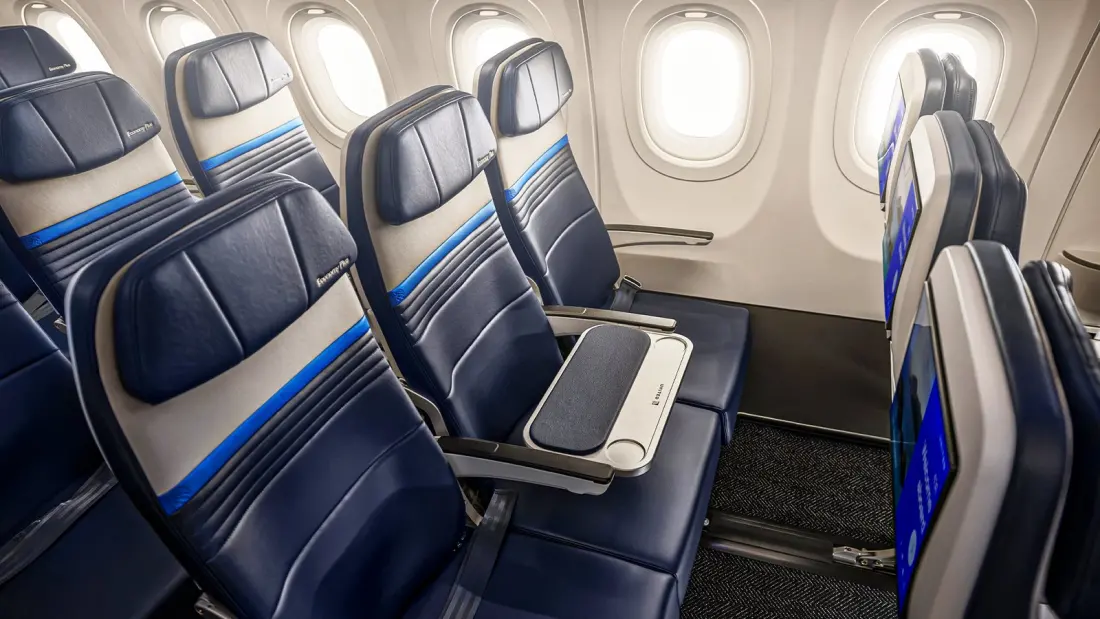
United Airlines has found a neat way to turn an empty middle seat into revenue. On its new Airbus A321XLRs, seats 32B and 32E aren't for sale — they're permanently blocked, with a cocktail table and cupholders fitted in their place. The aisle and window seats beside them, 32A, 32C, 32D and 32F, are sold at a premium as 'Economy Plus with Extra Elbow Room'. So while the aircraft is technically fitted with 152 seats, only 150 are sellable, along with 34 Economy Plus seats rather than 36.
Why block two perfectly good seats? It comes down to crewing. The FAA generally requires one flight attendant per 50 passengers, so a 152-seat aircraft would need four crew — but sliding doors on the Polaris suites automatically add a fifth anyway. Keeping capacity at 150 means United can roster four attendants on shorter flights and only pay for the fifth on longer ones. Losing two middle seats costs less than staffing them, and charging extra for the neighbour seats claws back some cash. Only Frontier among US airlines does anything similar, and it's rare on long-haul routes; American, fitting 155 seats on the same aircraft type, hasn't followed suit.
The A321XLR itself is a new chapter for United. Ordered in 2019 and entering service in 2026, the 50-plane fleet replaces the Boeing 757-200s. It's currently flying Washington Dulles to San Diego and Los Angeles, and from December it will debut internationally on Dulles–Amsterdam and Dulles–Dublin — the latter pair becoming year-round services instead of pausing over winter. Summer 2027 brings new routes to Toulouse, Luxembourg, Ibiza, Valencia and Marseille, all thinner markets that can't fill a widebody profitably.
Cabin layout: 20 Polaris suites with sliding doors, 12 Premium Plus seats, 34 Economy Plus and 84 standard economy. One catch for transatlantic travellers — the plane has no dedicated crew rest area, so on augmented-crew flights some passenger seats get blocked for resting crew, unlike the 777s and 787s with their bunks.
United is also experimenting elsewhere in economy. From 2027, a 'Relax Row' will offer three or four economy seats with extendable legrests forming a flat surface you can pay to sleep on. Neither product is luxury, but both show a carrier trying to monetise a cabin that hasn't changed much in a decade — while quietly reducing the supply of unloved middle seats.
For passengers, the takeaway is practical: on these narrowbody long-haul flights, the aisle and window seats next to the cocktail table are a genuine comfort upgrade if you're willing to pay a bit more, and they exist only on this fleet of 50 aircraft. Book early if you want one — there are just four per plane.