A Sunday excursion to the Rhode Island beaches should have been an uneventful outing. Instead, on the morning of 12 August 1853, a train packed with around 475 holidaymakers steaming south from Uxbridge, Massachusetts, met a northbound passenger train head-on on a single stretch of track near Valley Falls, between Pawtucket and Providence. Fourteen people died and at least seventeen were seriously hurt when the wooden carriages telescoped into one another.
The culprit, in part, was time itself. Before the United States adopted standard time, every town kept its own local solar time, and neighbouring clocks could disagree by several minutes. Railways ran on timetables and the personal watches of conductors and engineers, a system that worked tolerably for horse-drawn travel but became lethal at train speeds. On single-track lines, where opposing trains were meant to meet and pass at designated points, a few minutes of error could put two trains on the same rails at once — which is exactly what happened.
The northbound train from Providence had already waited six minutes at Pawtucket and crept forward onto the single track. The excursion train was running late, and its conductor, Frederick W. Putnam, pushed ahead at speed to make up lost time. Around 8 a.m., just past a curve, the two met. The excursion was estimated to be travelling at roughly 40 mph. An inquest found fault on several fronts: Putnam's watch was two minutes slow, he had a record of running behind schedule, the company had put an inexperienced conductor in charge of a huge excursion and issued no reliable watches, and the northbound crew departed one minute past their slot — a minute that might otherwise have placed both trains in sight of each other in time to stop.
The consequences were significant. The Providence and Worcester Railroad installed double track on its main line, removing the head-on risk. More broadly, the disaster became a touchstone in the push toward coordinated railway timekeeping — a reform that eventually arrived in 1883, three decades later, as standard American railway time.
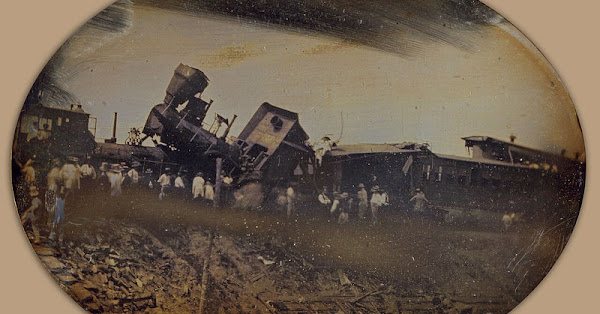
The crash also holds a quieter distinction. A Pawtucket photographer named L. Wright reached the scene with a daguerreotype camera and recorded the wreck, crowds gathered around the splintered locomotives. It is widely described as the first train wreck ever photographed, and it was reproduced as a wood engraving in the New York Illustrated News later that month — an early moment when ordinary readers far away could see a disaster rather than just read about it.
For travellers, the story is a reminder of how much of the modern world — synchronised clocks, time zones, even the convention of scheduling — was hammered out after avoidable tragedies like this one. Anyone exploring the Providence area can trace the old railroad corridor between Providence and Pawtucket, and the Blackstone Valley towns beyond it, where the region's industrial and railway history is still visible in mill towns and old alignments. It pairs well with Rhode Island's shoreline, the very beaches those 1853 excursionists never reached.