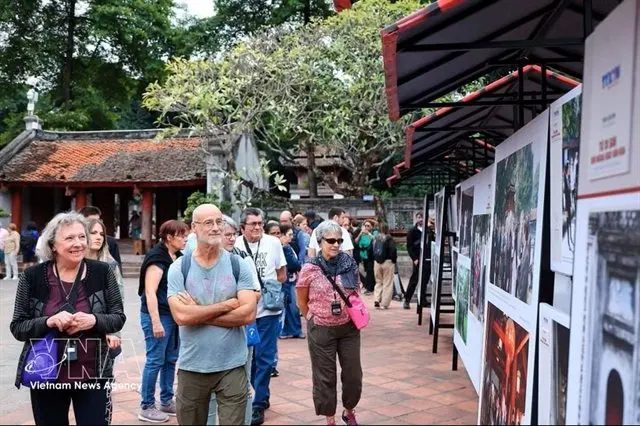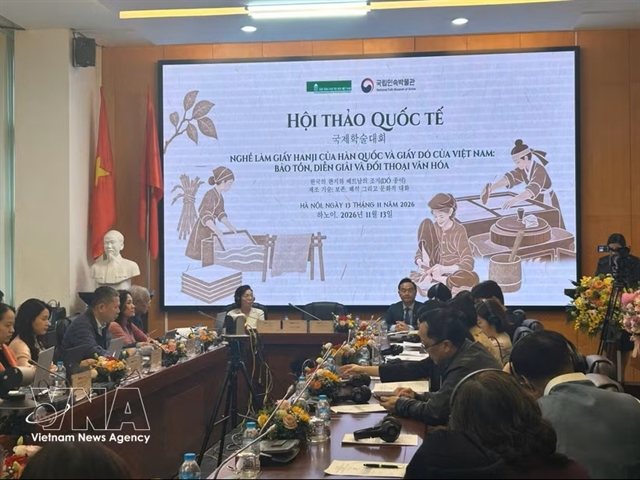
Two of Asia's best-known traditional paper crafts took centre stage in Hà Nội on November 13, when Việt Nam and the Republic of Korea held a joint conference on keeping hand-made paper alive — not just in archives, but in working communities.
The event, run by the Việt Nam Museum of Ethnology and the National Folk Museum of Korea both in person and online, gathered diplomats, researchers, museum staff and artisans from both countries. It was timed to Việt Nam Culture Day (November 24) and the 73rd anniversary of the Việt Nam Academy of Social Sciences.
At the heart of the discussion: Korea's Hanji and Việt Nam's dó (poonah) paper. Both crafts, organisers argued, carry embedded knowledge — about materials, technique, labour and how the paper is actually used in cultural life. Documentation alone, the Việt Nam Museum of Ethnology's director Lê Hải Đăng stressed, isn't enough without artisans, communities and younger generations learning the trade.
The programme was split into three sessions. The first looked at local knowledge and transmission, using Bắc Ninh's dó paper and Korean Hanji as case studies in how traditions adapt and survive. The second turned to museums, education and contemporary practice — artisan participation, craft ecosystems and the connection between exhibition spaces and living heritage. The third widened the lens to international museum cooperation and intercultural education.
There was a hands-on element too, with live demonstrations of Korean Hanji, Bắc Ninh dó and Cao Bằng's Nùng dó paper-making — a nice reminder that these are working crafts you can still watch being made today.
For travellers, this is a nudge toward cultural experiences that go well beyond the usual itinerary. Bắc Ninh, a short trip from Hà Nội, is known as the cradle of Vietnamese folk culture and home to dó paper workshops where you can see artisans at work. Cao Bằng, in the far northeast, pairs its Nùng paper-making villages with some of Việt Nam's most dramatic mountain scenery, including the Bản Giốc waterfall on the Chinese border. Korea, meanwhile, has built a whole tourism circuit around Hanji, especially around Jeonju, where visitors can try the craft themselves.
The conference also signals something practical: both countries are investing in making these crafts viable, which usually means more workshops, demonstrations and community-based experiences for visitors — and a better chance the crafts survive your visit. If you're drawn to slow, hands-on travel, adding a paper-making village to a Hà Nội or northern Việt Nam trip is an easy win.