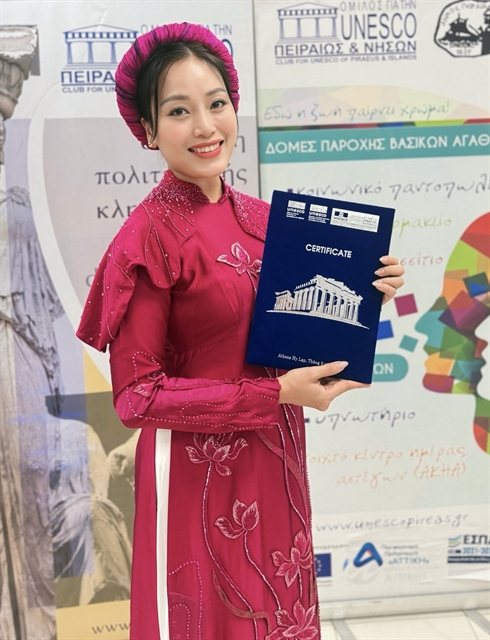
Vietnamese singer Huyền Trang has picked up the 2026 Pioneering Artist in Safeguarding and Promoting Folk Music Award from the UNESCO Associations Network, presented at a ceremony in Athens, Greece. The honour recognises more than a decade of work keeping Vietnamese folk traditions alive — not by freezing them in place, but by making them work in a modern setting.
Her breakthrough came in 2013, when she won the folk music category at the Sao Mai Singing Contest, Việt Nam's only nationwide competition spanning three genres: chamber music, folk-inspired music and pop. First staged as the National Television Singing Festival in 1997, Sao Mai is now nearly 30 years old and has launched many of the country's best-known singers. This year's winners will be announced on 22 November.
In an interview with Việt Nam News after the Athens ceremony, Trang was quick to frame the award as shared credit rather than personal glory. She pointed to the wider community of Vietnamese artists working on traditional music, and said the recognition should be read as encouragement for all of them. Her own approach, she explained, is to weave folk elements into contemporary arrangements while respecting the original spirit of the songs.
The Greece trip turned out to be more than a trophy run. Trang used the occasion to introduce Vietnamese music to an international crowd, meeting people from different cultural backgrounds and seeing how music crosses language barriers. Visiting Greek sites with more than 4,000 years of history also left a mark — she came away impressed by how seriously Greeks treat their own heritage. The contacts she made have already generated ideas for future exchange projects pairing Vietnamese folk music with artists from other countries, part of a longer-term goal to bring Vietnamese musical traditions to audiences abroad with more investment in visual presentation and cultural storytelling.
She also had advice for this year's Sao Mai contestants, who have been giving familiar folk songs contemporary twists. Creativity is welcome, she said, but innovation grounded in tradition matters more than radical reinvention — with only around five minutes on stage, audiences rarely get enough time to absorb arrangements that stray too far from the originals.
For travellers, the story is a useful nudge. Vietnam's folk music scene — from northern quan họ singing to central ca Huế on the Perfume River — is one of the country's most rewarding cultural experiences, and artists like Huyền Trang are making it increasingly accessible to visitors who don't speak the language. If your trip coincides with the Sao Mai season, the televised contest is a free masterclass in where Vietnamese traditional music is heading.
Report by Việt Nam News Life.