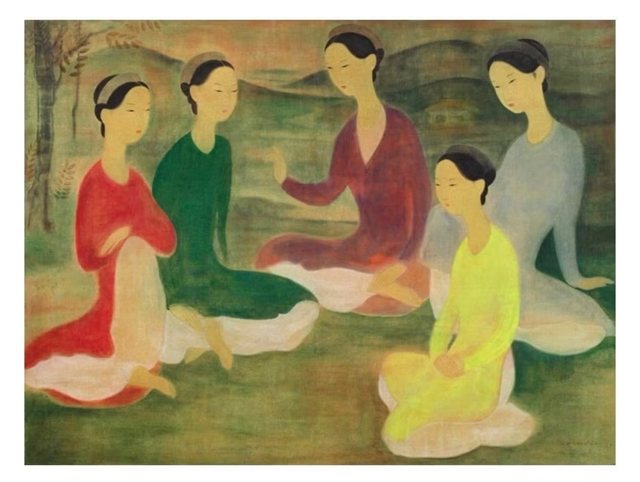
A 1939 silk painting by Vietnamese master Vũ Cao Đàm has just become the most expensive Vietnamese artwork ever sold at auction. Conversation d'élégantes au jardin (Conversation of Elegant Ladies in the Garden) went for HK$28.96 million — roughly US$3.69 million — at Sotheby's Hong Kong, well above its pre-sale estimate of HK$8 million to 19.6 million.
The previous benchmark was Mai Trung Thứ's Portrait of Mademoiselle Phương, which fetched HK$24.4 million in 2021. The new record confirms something collectors have suspected for a few years now: Vietnamese modern art is no longer a niche corner of the Asian market.
The painting itself is a technical marvel. Measuring 85.6cm by 114.5cm, it is unusually large for silk — a medium that allows almost no correction, since colour sinks into the fabric immediately. Five women in áo dài-style dress sit in a garden, each posed differently, none meeting the viewer's eye. The artist's son, Michel Vu, has described it as one of his father's high points, an Eden-like vision of happiness rendered through an Eastern lens.
Vũ Cao Đàm belongs to the generation of Vietnamese artists whose careers unfolded between Việt Nam and France — he painted this work in France in 1939, fusing an Asian material with European modernist training. That cross-cultural story is a big part of why international buyers keep bidding.
The record sale wasn't an isolated event at the auction. Trần Lưu Hậu's Park more than doubled its high estimate, selling for HK$2.816 million. Lê Phổ's La Fleuriste and Vase avec tournesols brought in HK$1.92 million and HK$2.304 million respectively, while Trần Bình Lộc's Angkor Wat Temple also made HK$1.92 million. The message is that value now extends beyond a handful of famous names — quality works with distinctive styles are finding buyers too.
For travellers, this is a good moment to pay attention to Vietnam's art scene on the ground. Hanoi's Fine Arts Museum holds an excellent collection of silk painting and lacquer from this exact era, and galleries in Hanoi and Ho Chi Minh City showcase both the masters and their contemporary heirs. Understanding what a Vũ Cao Đàm fetches abroad adds a layer of appreciation when you encounter these works — or hunt for affordable pieces by emerging artists — during a trip. Vietnam has also been pushing culture as a national asset, with recent policy framing creative industries as central to the country's development, so expect more museums, exhibitions and art-focused experiences aimed at visitors in the coming years.
Nearly nine decades after it was painted, far from the homeland it evokes, the painting has found both a new audience and a striking new price. For anyone planning time in Vietnam, it's a reminder that the country's cultural output carries weight well beyond its borders — and that some of the best context for it is found in Hanoi's galleries and museums rather than an auction room.