Turkey's Turquoise Coast hides one of Europe's great long-distance walks. The Lycian Way runs roughly 540km between Fethiye and Antalya, threading pine forests, mountain passes and quiet coves along a coastline settled as far back as 2000 BC. The whole trail takes around 30 days on foot, but you don't need a month — a well-planned week covers some remarkable highlights.
The trail's real magic is how much ancient history sits right beside the path. Near Antalya, a stiff climb from Geyikbayırı leads to the overgrown ruins of Trebenna, a Hellenistic and Roman city with scattered tombs and civic buildings. Further south, Phaselis near Tekirova is arguably the most atmospheric site on the whole coast: a Greek-founded port with three natural harbours, where ruined shops, an agora and a theatre lie shaded by pines, with small beaches lapping the ancient waterfront. Hadrian's triumphal arch still marks the emperor's second-century visit.
Then there's Chimera above the village of Çıralı — a 30-minute dusk walk to rocks where methane seeping through fissures has been burning continuously for at least 2,500 years. The Greeks thought it was the breath of a lion-goat-serpent monster. Today it's an eerie natural light show above a twinkling coastline.
Along the Kapaklı to Üçağız stretch, you pass sarcophagi and rock tombs before reaching Simena, a city partially swallowed by the sea after a second-century earthquake. The water is clear enough to spot submerged building foundations, and a crusader castle on the old Lycian acropolis shelters a tiny Roman theatre carved from solid rock.
Near the Fethiye end, the trail delivers two emotional punches. The Tomb of Amyntas, carved into a limestone cliff in the fourth century BC, looks like a Greek temple façade and rewards the climb with sweeping views over the town and its gulf. And the abandoned village of Kayaköy — once the Greek Orthodox settlement of Levissi — stands frozen since the 1920s population exchanges, hundreds of roofless stone houses spilling down the hillside, two churches still prominent among the ruins.
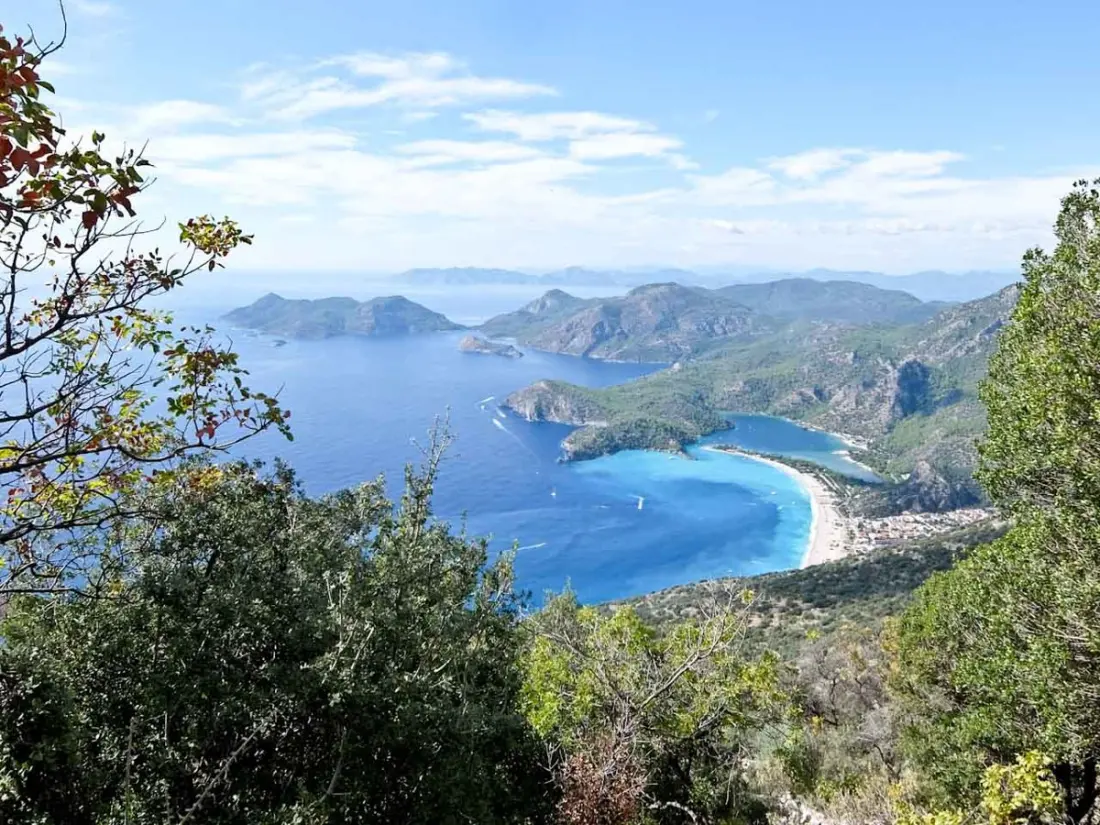
One of the most scenic sections runs from cliffside Faralya over the slopes of Mount Babadağ (1,975m, a paragliding hub) with the famous Ölüdeniz blue lagoon below, dropping via 4km of switchbacks to the official trailhead arch at Ovacık.
Who is this for? Confident hikers with a taste for ruins — this is real mountain walking, not a coastal stroll. SunExpress flies direct from London to both Antalya and Dalaman, so a one-way week hiking a section (with a guide or the detailed Lycian Way guidebook) is entirely doable. Base yourself at Alp Pasa in Antalya's old town, Lukkies Lodge in Çıralı for the Chimera flames, or Ansira in Fethiye for sea views.