
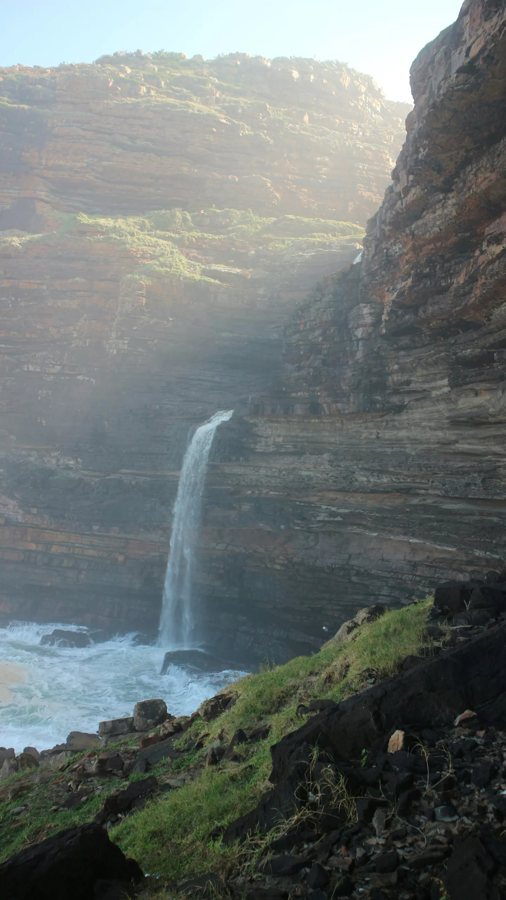
Most waterfalls end in a river mouth or a pool. On South Africa's Wild Coast, one takes a more dramatic route: at Waterfall Bluff in the Eastern Cape, the Mlambomkhulu River — its name means 'big river' — runs to the edge of the coastal cliffs and plunges nearly 100 metres directly towards the Indian Ocean, according to the Pondoland Marine Protected Area.
The bluff sits between Port St Johns and Mkambathi Nature Reserve, near the small settlement of Mbotyi and south of the Msikaba River. Its sheer cliffs are shaped by the Egosa Fault, one of the geological quirks that give this stretch of Pondoland coastline its deep gorges, rocky headlands and abrupt drops. Freshwater meets saltwater not in an estuary but mid-air.
Don't confuse it with the falls inside Mkambathi Nature Reserve itself — Horseshoe Falls, Strandloper Falls and Mkambathi Falls are separate attractions, though the reserve protects 7,720 hectares of the same wild landscape: grassland, indigenous forest, wetlands and about 10 kilometres of undeveloped coast. The area falls within the Pondoland Centre of Endemism, home to plants that grow nowhere else on Earth, and Cape vultures can be spotted around the Msikaba gorge cliffs. Just offshore, the pyramid-shaped Cathedral Rock rises from the sea.
Seeing Waterfall Bluff takes effort. The route is a point-to-point trail of roughly 15.8km with about 311m of elevation gain, rated moderately challenging and taking around four hours. There are no viewing platforms or parking bays — you walk through coastal grassland until the land opens up to cliffs and falling water, which is precisely the appeal. Longer-distance hikers can fold it into sections of the Wild Coast Hiking Trail, which runs for hundreds of kilometres.
Timing matters. The Wild Coast is warm and humid, with most rain between September and February; March tends to be the wettest month and June the driest. After heavy rain, river crossings and exposed cliff paths get tricky, so check local conditions before setting out and allow extra time. Strong coastal winds are another factor to plan around.
This is a trip for travellers who prefer their highlights unpolished — hikers, photographers and anyone keen on a genuinely remote corner of South Africa. Pair the waterfall with a stay around Mbotyi or Mkambathi and you have a proper wilderness few days, not a tick-box stop. All credit to the reporting by Getaway South Africa.