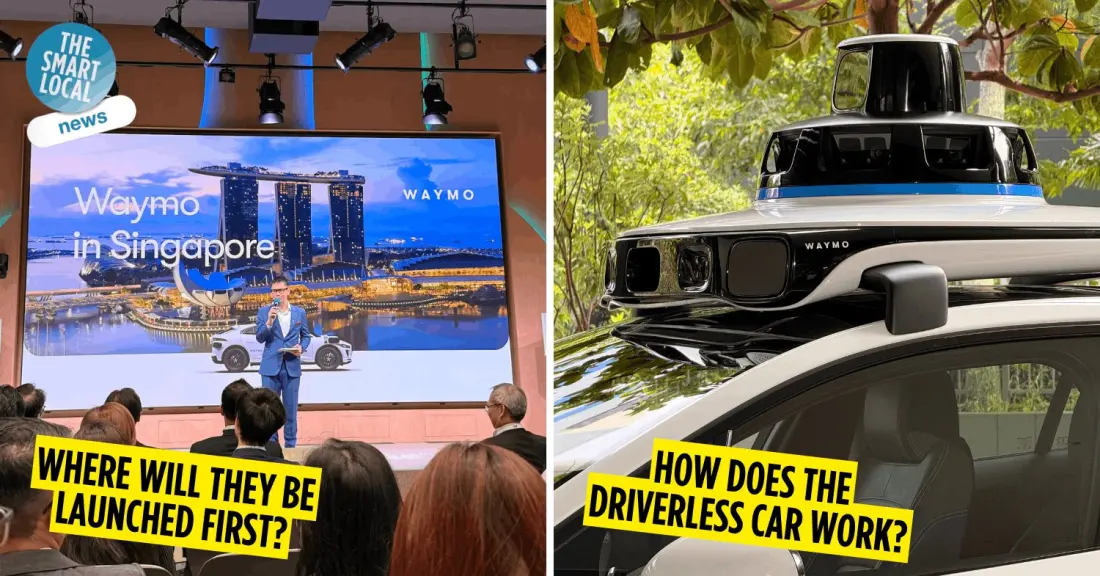
Alphabet's self-driving arm Waymo has set a 2028 target for launching a fully driverless ride-hailing service in Singapore, where passengers would book a car through an app and find genuinely no one in the driver's seat. It would be one of the first commercial robotaxi services of its kind outside the US.
The rollout has three stages. Waymo's first vehicles are expected to arrive in the coming months, with testing and familiarisation runs on local roads through 2027. Public rides are then slated for 2028. Testing matters because Singapore's regulators require autonomous vehicles to prove they can handle local conditions - sudden tropical downpours, motorbikes filtering between lanes, cyclists, buses and ERP gantries - before carrying passengers without a safety operator.
The launch area is the west of the island rather than the northeast, with operations centred around Labrador and Harbourfront. Planned use cases include commutes, weekend trips and serving industrial zones that are currently underserved by public transport.
Waymo isn't starting from zero here. Public driverless shuttles have already been running in Punggol since April 2026, and that trial is expanding from fixed routes to point-to-point rides across the whole estate, with a future link to Sengkang General Hospital. Autonomous buses are being piloted, and Tampines North and Tengah are named as candidate HDB towns for further AV deployment. Singapore has been in this game since at least 2015, when the CETRAN testing facility opened at NTU, and early self-driving taxi trials by nuTonomy date back to the 2010s.
What's arriving is a proven international operator. Waymo began as Google's self-driving project in 2009, has logged more than 200 million fully autonomous miles, and runs commercial driverless services in several US cities. A Tokyo launch is planned for 2027. Its current fleet uses electric Jaguar I-PACEs, with newer purpose-built vehicles and Hyundai IONIQ 5 partnerships on the way, so the exact cars in Singapore may differ. The fleet is all-electric, aligning with the Singapore Green Plan 2030, and the company estimates its global operations already avoid around 480 metric tonnes of CO2 weekly - though that figure comes from US operations.
Officials are positioning robotaxis as a complement, not a competitor. Transport Minister Jeffrey Siow has stressed that trains and buses remain the backbone, with autonomous vehicles filling gaps - the last mile from your HDB block to the MRT in a thunderstorm, late-night trips after the last train, or routes human drivers avoid. In July 2026 the Ministry of Transport announced training pathways to help existing taxi and private-hire drivers move into AV-related jobs. Work on a full legal framework covering liability, insurance and enforcement is ongoing, so expect more rules before the first driverless fare is charged.
For visitors, this is less a 2028 holiday hook than a signal of where Singapore is heading: a city already treating driverless transport as infrastructure. If you're in the west of the island in a few years' time, your airport transfer might quietly have no driver at all.