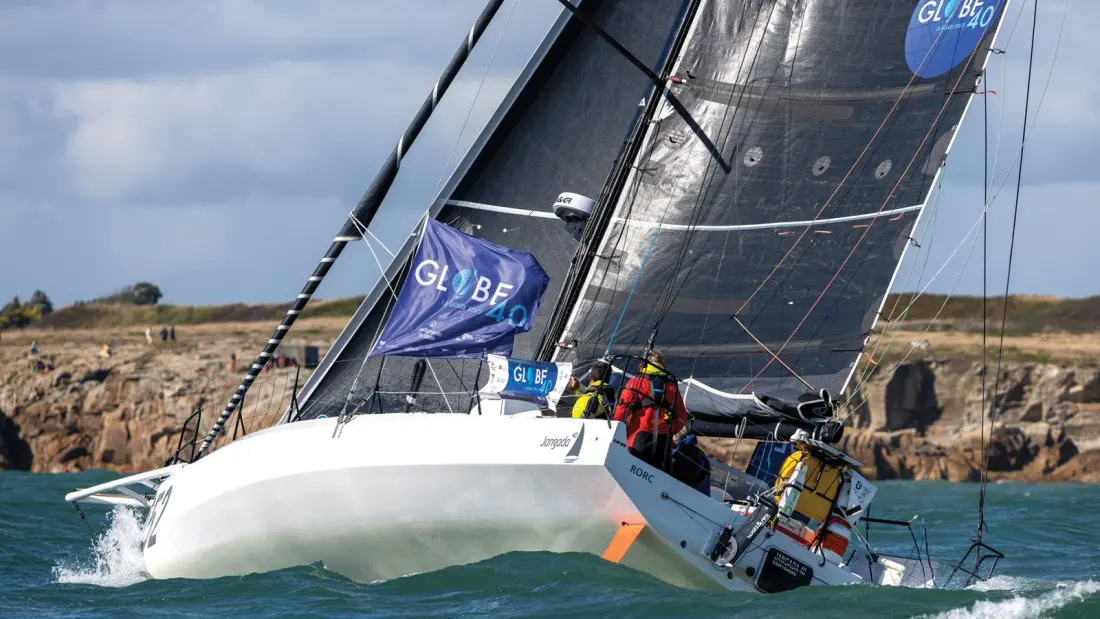
Racing around the world double-handed through the Great Capes is about as brutal a shakedown as boat kit can get. Rupert Holmes put a full suite of electronics, a watermaker and comms gear through the Globe40 race aboard the Class 40 Jangada 40, and his verdicts after 34,000-plus miles are worth reading for anyone fitting out a bluewater yacht.
On the safety side, the standout was a clever AIS upgrade. Instead of a standard Class B transponder pinging at 2 watts, the team ran an Emtrak B953 Class B+ unit at 5 watts, pushing detection range from 6-8 miles out to 16-18 for barely any extra power draw. That mattered: ships in the open ocean routinely altered course 12 miles away — beyond the reach of standard gear. For VHF, a B&G V60 with wireless-charging remote handsets allowed full 25W transmission via the masthead antenna from anywhere on deck.
Radar proved a mixed bag. The B&G Halo24 tracked night squalls reliably and even picked up small unlit wooden fishing boats at roughly 0.75 miles, though the interface is clunky and the MARPA target tracking takes real learning. A keel camera from Offshore Tec turned out to be a genuine game-changer: the crew snagged everything from a 20m length of polypropylene line to fishing nets, a heavy hawser, Patagonian kelp and 1,800 miles of sargassum, and the helm-mounted feed made clearing each one quick. Caveat — the first camera flooded mid-race.
The Katadyn PowerSurvivor 40E watermaker delivered a steady 5 litres an hour at just 12W per litre, with a manual handle as a power-failure backup — though you need to plan its mounting space to actually use that handle. One gotcha for fast boats: an intake placed forward of the keel sucks in air above 3-4 knots, so plumb it low and aft instead.
Autopilot redundancy was the quiet hero. Two Raymarine linear rams on separate data buses, each with its own B&G H5000 computer, plus a Pixel sur Mer Exocet overlay that can drive either ram and steer to heel angle in gusts — the team never had to switch to backup in anger, and the heel safety mode kept them upright and fast while rivals broached.
Starlink transformed life at sea — a race doctor once diagnosed a burn via WhatsApp photo — but it's power-hungry (6-8A running, 13A on startup), slow to connect deep in the Southern Ocean, and the smaller Mini units underperformed so badly that every team switched to permanent transom mounts. Prudent crews still carry an Iridium satellite phone for voice calls and a low-power tracker like the YB3 in the grab bag; the Iridium GO! Exec is a cheaper, flexible alternative to a full Certus backup.
For sailors planning offshore passages, the takeaways are refreshingly practical: spend on redundancy, choose the higher-power AIS option, and never assume your watermaker intake or camera seals are right until tested at sea.