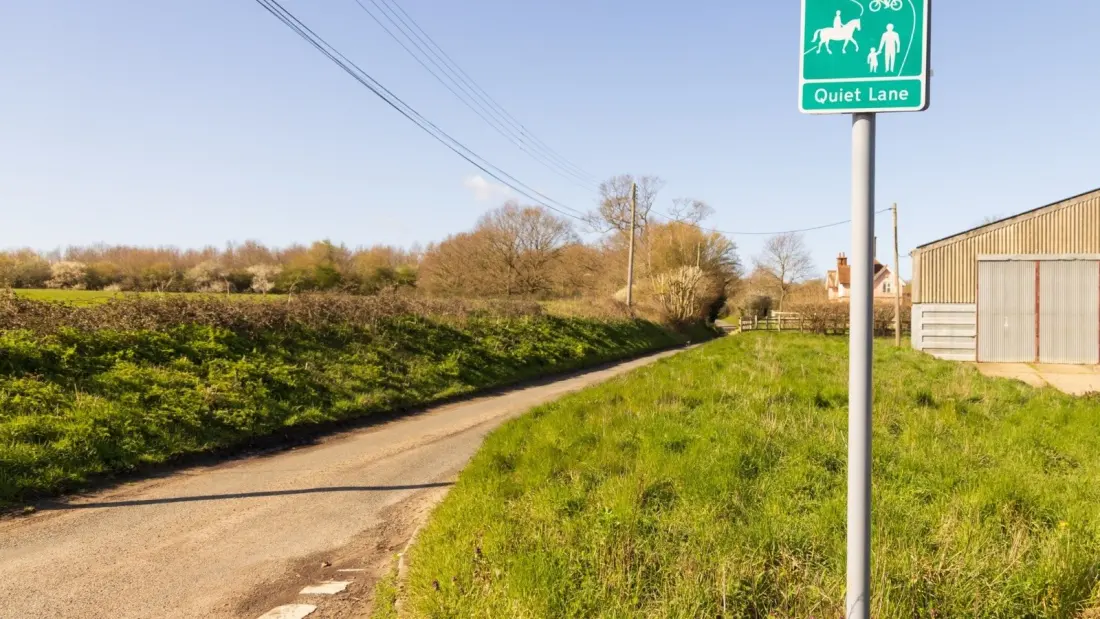
Spot a green British road sign showing a car, a cyclist and a horse rider all together? You've found a 'Quiet Lane' — and it's one of the UK's more charming quirks of the countryside. Despite the crowded artwork, these are exactly what the name promises: single-track country roads kept calm and slow, where walkers, joggers, cyclists and horse riders take priority and drivers are expected to ease off.
The rules are official, not just a courtesy. Highway Code Rule 18 tells motorists to drive carefully on quiet lanes and give way to people on foot or horseback. The idea has backing from the Campaign to Protect Rural England, which promotes the scheme both for safer roads and to encourage locals to walk or cycle short trips instead of driving. There's a serious safety angle too: government figures show rural roads carried only 45% of UK traffic but accounted for 60% of road deaths in 2025 — a disparity Quiet Lane designations aim to shrink.
Where do you find them? Norfolk's quiet lanes wind inland from the coast through farming villages and old hedgerows, well away from the cliffs and marshes. Suffolk's link to rivers and open fields via footpaths, and Sussex has at least 13 designated lanes spread across seven parishes. The signs tend to sit discreetly at the start of each lane, so keep an eye out — you could easily roll onto one without realising it, which is rather the point.
If you're planning to walk or cycle one, a few habits make it work for everyone. Wear bright clothing so drivers spot you early, and leave the earbuds out — you'll hear traffic and hooves coming, plus actually enjoy the birdsong. Keep dogs on a short lead and bag the mess. Cyclists should fit a bell or call out a friendly hello when passing. And expect surprises: footpaths open onto these lanes through gaps in hedges, so people and animals can appear from nowhere.
For travellers, quiet lanes are an easy, free way to see the English countryside at ground level — no tickets, no crowds, just hedgerows, villages and the occasional tractor. Pair a Norfolk or Suffolk lane walk with a coastal base, and if you like the freedom, head north: Scotland's right-to-roam law lets you wander almost any open countryside you fancy. Just remember the basics of British driving if you're renting a car — left side, clockwise roundabouts, and a whole menagerie of unusual signs, from exploding-car warnings to toad crossings.