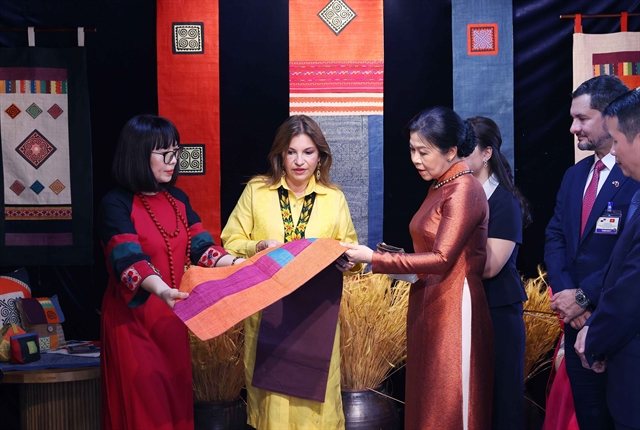
Two first ladies, one shared love of fabric. At Hồ Văn, the lake-side garden within the Temple of Literature complex in Hà Nội, Vietnam's Ngô Phương Ly — wife of President Tô Lâm — hosted Panama's Maricel Cohen de Mulino for a showcase of the country's ethnic minority textile traditions this week.
The visit went well beyond a polite look at costumes. The two women met artisans and walked through the stages behind traditional handicrafts from the Tà Ôi, Red Dao and Blue Hmong communities, watching live demonstrations of indigo dyeing and the beeswax-batik technique used to paint patterns onto cloth. They also heard the meanings behind the motifs — because in these communities, the colours and designs aren't decoration for its own sake. They encode history, customs and each group's distinct identity, passed down through generations of weavers and embroiderers.
The surprise of the day came from the guest herself. Cohen de Mulino said she spotted patterns she recognised from home: Panama's Guna people are famous for their mola, a reverse-appliqué textile art, and she noted real similarities with the colours, patterns and techniques used by Vietnam's Mông (Hmong), Dao and Thai peoples. Two countries separated by an ocean, apparently thinking along the same design lines.
For Madame Ly, the point of the event was bigger than heritage preservation as museum-keeping. She argued that keeping traditions alive means giving them a future: supporting craft groups — especially ethnic minority women, people in poverty and those with disabilities in remote areas — creates jobs and income, and helps revive endangered crafts like brocade weaving, pottery, basketry and wood carving. The approach also includes practical modernisation: designing products for contemporary markets, building management skills and taking Vietnamese handicrafts to international buyers.
The afternoon closed with tea and an áo dài show, and a conversation about how culture builds bridges between peoples. Both sides expressed hope for more cultural exchanges between Vietnam and Panama.
Why should a traveller care? Because this is exactly the kind of craft culture you can experience first-hand in northern Vietnam. Villages around Sapa, Ha Giang and Mai Chau offer chances to see indigo-dye vats, beeswax pattern-painting and backstrap looms in action — and to buy directly from the women who make them, which is precisely the income support the event championed. The Temple of Literature itself, where this happened, is one of Hà Nội's loveliest heritage sites and pairs well with the Vietnam Museum of Ethnology for a deeper dive into the country's 50-plus ethnic groups.
Who it's for: travellers drawn to textile trails, artisan workshops and slow cultural tourism — and anyone who enjoys the idea that a pattern stitched in the mountains of Vietnam can look like one stitched on the Caribbean coast of Panama.