The Temple of Literature – Imperial Academy in Hanoi isn't just another pretty heritage site. An Indian academic with long ties to Vietnam says it's one of the country's most powerful cultural assets — and her reasoning gives travellers a fresh lens on a place many visitors rush through.
Professor Reena Marwah, president of the Association of Asian Scholars in India, has spent more than a decade working with Vietnamese universities and research institutes. Speaking to the Vietnam News Agency in New Delhi, she described Văn Miếu – Quốc Tử Giám as the clearest symbol of Vietnam's respect for learning. Founded under the Lý Dynasty, which ruled from 1009 to 1225, it was the country's first university — a near-1,000-year-old institution built on Confucian values of respecting teachers, social fairness and ethical conduct.
Marwah has visited the complex during trips to Hanoi and says one image stays with her: students arriving to offer incense and pray before major exams. It reminds her of home. In India, young people pray to Saraswati, the Hindu goddess of knowledge, music and the arts, before tests and academic milestones. The parallel, she argues, shows how much common ground India and Vietnam share when it comes to education and spiritual life — common ground she'd like to see turned into stronger cultural exchange between the two countries.
Her bigger point is about soft power. Vietnam's appeal abroad, she suggests, isn't limited to scenery, street food and áo dài. Its academic traditions, Buddhist heritage and the legacies of the Champa and Oc Eo civilisations give it intellectual depth that most travellers never hear about. That heritage, she believes, could raise Vietnam's international standing and draw more scholarly and cultural visitors.
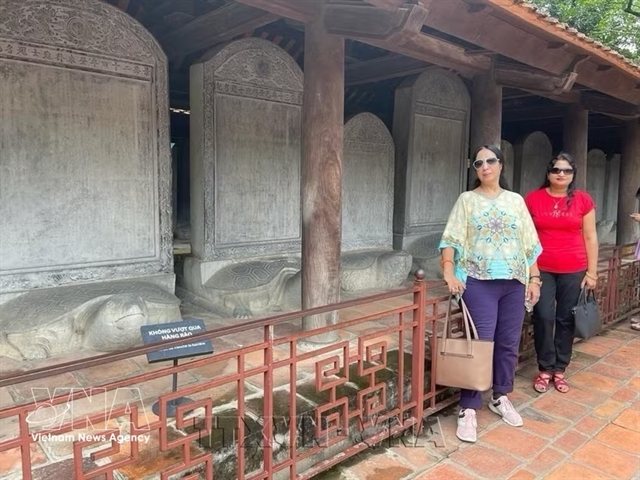
For anyone planning a trip to Hanoi, the practical takeaway is simple: give the Temple of Literature proper time. The complex houses the doctoral laureates' steles — stone tablets mounted on turtle backs recording the names of graduates from centuries past — and they're among the most historically significant artefacts in the country. Visiting during exam season adds another dimension, when local students turn the courtyards into sites of quiet, hopeful ritual. Pair it with a walk through the surrounding Old Quarter and you get a sense of Hanoi as a city of learning as much as a city of phở and motorbikes.
The story matters for travellers because it reframes Vietnam. Beyond beaches, caves and coffee, there's a millennium-old scholarly tradition sitting in the middle of its capital — one that connects Vietnam to India in ways few tourists realise, and one that makes an ordinary sightseeing stop feel considerably richer.