Archaeologists working in Gunma Prefecture, northwest of Tokyo, have pulled a remarkable figure out of the mud: a hollow clay statue, about 40 centimetres tall, that may depict a shrine maiden from roughly 1,500 years ago.
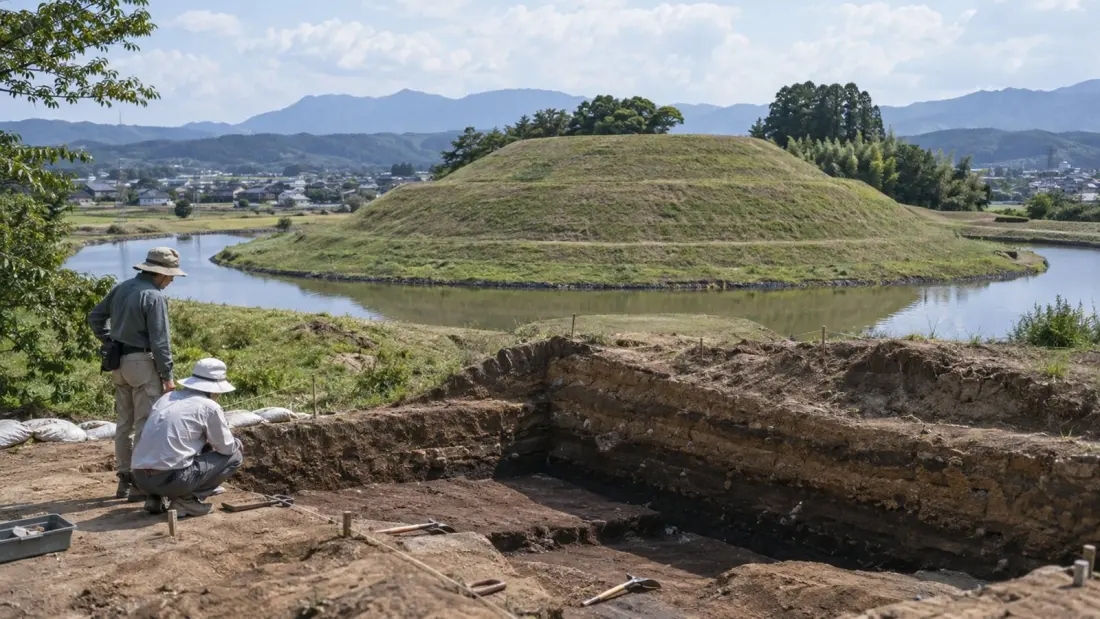
The figure is a haniwa, one of the terracotta sculptures that ancient Japanese communities placed on and around their great burial mounds. This one turned up at Nishikaminomiya in Isesaki, a site that teams have been excavating since 2020 ahead of river works along the Tone River. Only the head and torso survive, so the original statue was probably much bigger. It was found in the moat of the site's largest tomb, a circular mound about 45 metres across, and researchers think it tumbled down from the top sometime over the centuries.
Why do they think she was a priestess? The details are telling. Her hair is styled in a topknot linked to shrine maidens of the Kofun period (roughly 300 to 710 A.D.), the era of giant tombs that gives the age its name. She wears bracelets of clay and red pigment on both wrists, a red sash crosses her torso, and in her left hand she grips a rod-like object believed to be a ritual implement. In Shinto, a miko acts as a bridge between humans and the spirit world, and priestesses are thought to have played a real part in funeral rites. If the identification holds, the statue is rare physical evidence of women's religious roles in early Japan.
There's an interesting side note about craftsmanship: the sculptors lavished care on details nobody could see from ground level, which suggests the community valued the figure far beyond decoration. The statue's findspot also changed how archaeologists read the tomb itself. What looked like a plain circle turned out to have a projecting section on its southern side, discovered in the 2026 digs, where the figure may once have stood near a boat-shaped sarcophagus inside the mound.
Haniwa first appeared around the third century and spread across Japan as elite families raised ever bigger mounds for their leaders. Many scholars believe the sculptures were meant to house the souls of the dead, so placing a priestess at a tomb fits a tradition where the figures carried genuine spiritual weight rather than being mere ornament.
For travellers, this is a good excuse to look beyond Tokyo and Kyoto. Gunma is easy to reach and offers hot-spring towns, mountains and a string of ancient tombs. There's one wrinkle for anyone hoping to see the statue soon: reports disagree on where it will be displayed, with one naming an excavation museum in Shibukawa and another the Gunma Prefectural Museum of History. Check with the institutions before setting out. The good news is that the Nishikaminomiya dig is finished and the figure is expected to stay on public view, close-up enough to study that carefully modelled red sash for yourself.