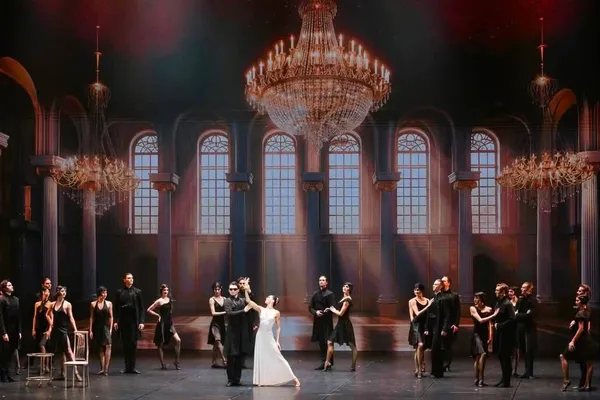
A contemporary ballet version of Pushkin's Eugene Onegin, staged by the renowned Eifman Ballet of St Petersburg, has just wrapped up a tour of Vietnam with a final performance in Hanoi on Saturday night. It's a rare chance for Southeast Asian audiences to see one of Russia's most celebrated contemporary companies, and it says something about how ambitious international performing arts are now touring this part of the world.
The source material is familiar to anyone who knows Russian literature: Pushkin's 1820s verse novel about the bored aristocrat Onegin, the earnest Tatyana whose declaration of love he coldly rejects, and the fateful reunion years later when the tables have turned. Choreographer Boris Eifman keeps the skeleton of that story but moves it to post-1991 Russia, just after the Soviet collapse, using the era's nightclubs and social upheaval to explore what happens to traditional values when the world around them falls apart.
The update changes the story's meaning in big ways. Tatyana's husband becomes a cold, inscrutable figure in dark glasses rather than a pillar of society, leaving her marriage in doubt. And Onegin — who in the original survives the duel with his friend Lensky and walks away into an unresolved ending — is here killed by Tatyana's husband. Eifman turns the classic 'superfluous man', the privileged young Russian adrift in his own life, into a doomed figure destroyed by guilt and desire.
Visually, the production is built for touring: minimal sets, dramatic lighting that shifts between moonlight and lamplight to mirror the characters' inner states, and a score that mixes Tchaikovsky and other orchestral pieces with a cello solo and rock arrangements by Alexandre Sitkovetsky. The stripped-back staging is part of why the company has been able to perform in more than 40 countries. Reviewers highlight the athletic, risky choreography — gravity-defying lifts, solo passages that chart Onegin's psychological unravelling — as the reason the show lands so hard with audiences.
For travellers, the takeaway is that Hanoi is increasingly on the map for world-class cultural events, not just street food and old quarter wanderlust. If a touring ballet, opera or orchestra announces a run at one of the city's theatres, it's worth building an evening around it — tickets are typically far cheaper than the equivalent show in Europe, and the venues themselves, often French colonial-era houses, are part of the experience. Keep an eye on listings around major tour announcements; productions like this tend to play only a handful of nights.
Even if you missed this run, the story is a good excuse to pair a trip to Vietnam with some pre-reading: Pushkin's novel is short, sharply written and widely available in translation, and knowing the plot makes any staging — classical or modern — far more rewarding.
Coverage via Vietnam News Life.