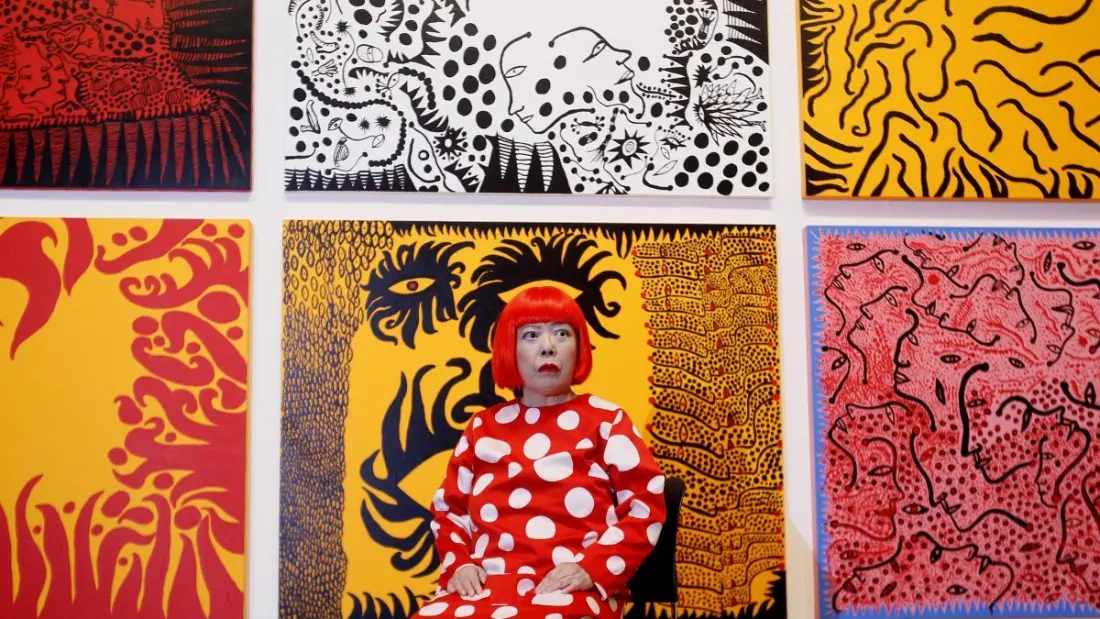
The polka dots are everywhere — on canvases, pumpkins, shop windows, entire rooms. But for Yayoi Kusama, the dots started as something frightening. Born in Matsumoto, Japan, in 1929, she began experiencing hallucinations as a child: flowers that spoke to her, patterns on a tablecloth that spread until they filled a whole room. Her response was to run home and draw what she had seen. Art became her way of managing the images rather than escaping them, and that habit has now sustained a career of nearly 80 years.
After a formative, often difficult childhood shaped by family tensions and wartime factory work, Kusama moved to New York, where in the late 1950s she started her 'Infinity Nets' — canvases covered in thousands of tiny loops, sometimes painted for days with barely any sleep. The repetition, researchers now suggest, functioned almost meditatively. A 2026 study, 'Yayoi Kusama's Art and Its Clinical Relevance to Neurovisual Phenomena,' goes further, reading her endless dots, lights and shifts of scale as visual cousins of conditions like visual snow syndrome and macropsia — making her work a rare vocabulary for perceptual experiences most people struggle to describe.
Since 1977, Kusama has lived voluntarily in a psychiatric hospital in Tokyo, commuting daily to a studio nearby. The hospital gives her structure; the studio gives the visions somewhere to go. It's an unusual arrangement that has produced one of art's most recognizable bodies of work — and, eventually, a global brand. Her 1969 boutique put dots on clothing and performances, and her Louis Vuitton collaborations, including life-size mannequins of Kusama herself in the brand's windows in 2012, carried her visual language into fashion worldwide.
For travellers, the real payoff is her 'Infinity Mirror Rooms.' Here her private perceptual world becomes architecture: mirrors and lights multiply until the room seems boundless, and you step inside it. What once terrified a child in Matsumoto is now an experience queues form for in museums from Tokyo to London and New York.
Her story also doubles as a cultural itinerary through Japan. Matsumoto, her mountain-ringed hometown, houses a museum dedicated to her work, while Tokyo remains the centre of her world — the site of major institutional shows and her famous pumpkin sculptures dotted across the country's art islands and galleries. Understanding the origin of the dots changes how you see them: less playful decoration, more a document of a mind that learned to live with itself by making things. Kusama didn't conquer her hallucinations; she built them rooms you can enter.
Daily Sabah Travel