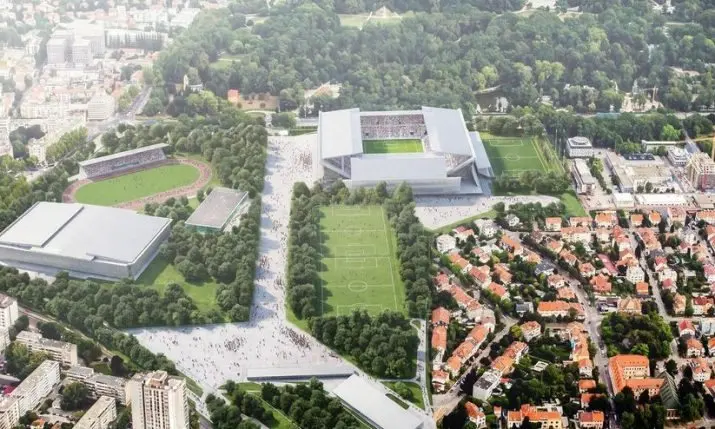
Zagreb's most famous football ground is finally getting its rebuild. An international competition for the new stadium at the Maksimir complex has been won by Italian studio VG13 Architects Studio Associato, led by architects Tommaso Fantini and Alberto Rossi. The contest for the SRC Svetice–Maksimir Stadium concept drew 88 entries from more than 20 countries, with five designs awarded prizes overall.
The competition ran from 20 March to 17 July 2026 and was organised by the Croatian Government and the City of Zagreb, with the Zagreb Society of Architects (DAZ) managing the process. Results were presented in the capital by DAZ president Ana Boljar, panel president Toma Plejić, and a jury that read like a who's-who of Croatian public life: GNK Dinamo president and former midfield great Zvonimir Boban, mayor Tomislav Tomašević, and Tourism and Sport Minister Tonči Glavina sat alongside Croatian and international architecture experts.
The winning studio now gets contracted to produce the conceptual, main and detailed design documentation — the paperwork needed for location and construction permits and, eventually, a public procurement tender for the build itself. There's still a road ahead: demolition of the current stadium is expected to start in 2027, with construction of the replacement slated for 2029.
For football fans, Maksimir needs little introduction. It has been the home of Dinamo Zagreb since the mid-20th century and hosted Yugoslavia's matches for decades, with its distinctive eastern grandstand once regarded as one of Europe's finest stands. A full redevelopment of the site — stadium plus surrounding sports complex — signals a major upgrade to one of the city's most storied corners.
Why should a traveller care? If your trip to Zagreb includes a match — and catching Dinamo in front of the Bad Blue Boys is one of the loudest, most atmospheric experiences in European club football — the stadium landscape is about to change. The current ground carries decades of history that will be gone after 2027, so anyone keen to see the old Maksimir should plan a visit sooner rather than later. After the rebuild, a modern arena will anchor the regenerated sports district east of the city centre, a short tram ride from the city's cafes and museums.
Zagreb itself stacks up well for a football-forward city break: compact historic core, coffee culture that rivals Vienna, cheap and reliable trams, and affordable match tickets compared to Western European leagues. Combine a game with the Upper Town, Dolac market, and Mirogoj Cemetery, and you have a genuinely good-value weekend.