Christmas market season is no longer just a Central European affair. A round-up of the 2026 festive calendar shows yuletide fairs stretching from Tokyo to Auckland, with everything from German-style mulled wine under neon skyscrapers to a floating lantern on an Austrian lake.
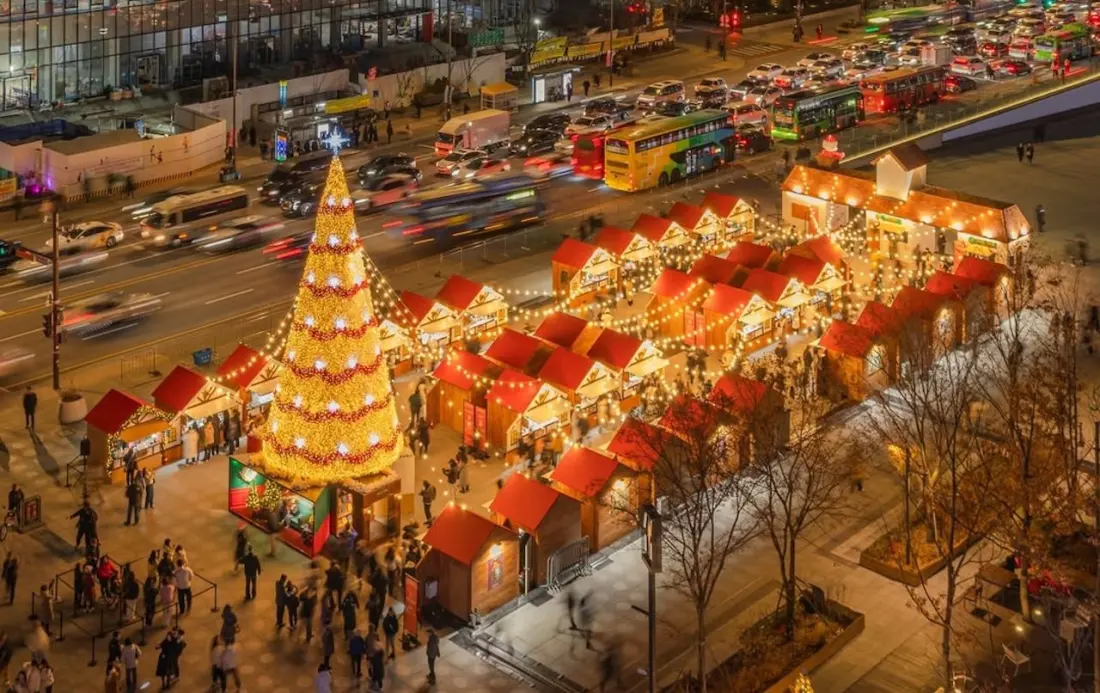
In Asia, Tokyo runs a German-flavoured Christmas market at two spots — Shin-Toyosu (20 November to 25 December) and Shiba Park (4 to 25 December) — complete with glühwein, goulash and a 14-metre German Christmas pyramid. Seoul's Gwanghwamun Square turns Santa's village from 4 December to 3 January, with over 100 red-roofed chalet stalls, a merry-go-round and a gift-laden express train. Singapore's Christmas Wonderland at Gardens by the Bay (November to 1 January) swaps snow for Supertrees lit up in dancing colours, plus fairground rides and a flying Santa.
Europe still anchors the scene. Zurich's market at Sechseläutenplatz has been revamped and renamed Bellevue Noël (20 November to 23 December), adding a 50-metre Advent wreath and a fondue chalet seating 400. Strasbourg, the self-styled "Capital of Christmas" with 455 years of market history, spreads eight themed markets and 300-plus stalls across its old town from 26 November to 24 December — look out for the eco-minded Marché OFF at Place Grimmeissen. Barcelona's Fira de Santa Llúcia, running since 1786, organises its hundreds of stalls by category, from nativity figures to simbombes, a traditional instrument. Brussels Winter Wonders (27 November to 3 January) packs 200 chalets around the UNESCO-listed Grand-Place, with a nightly sound-and-light show, ice rink and Ferris wheel.
For an Alpine twist, head 30 minutes from Salzburg to the Wolfgangsee, where three villages each have a theme: St Wolfgang floats an 11-metre lantern on the lake, St Gilgen glows with red candles, and Strobl becomes a nativity village with live animals. Ferries link them all. Elsewhere, Madrid's Plaza Mayor is the spot for hand-painted belenes (nativity scenes), Copenhagen's Tivoli Gardens pairs its stalls with fireworks on 25 and 26 December and a Nutcracker ballet, and New York's Bank of America Winter Village at Bryant Park (28 October to 28 February) offers free entry to its 1,580-square-metre ice rink — skates cost extra, but heated igloos can be booked. In Auckland, most markets are one-off dates rather than season-long, including the German Christmas Market on 14 November and the Downtown Christmas Market in mid-December.
The practical upshot: if you want the classic snow-and-glühwein experience, late November through mid-December in Europe is peak, and booking trains early (Paris to Strasbourg is under two hours by TGV) saves both money and stress. If you'd rather trade woolly hats for warm evenings, Seoul, Singapore and Auckland prove the festive season travels well. Either way, most big markets are free to enter, so the real budget goes on food, drink and the gifts you'll struggle to fit in your suitcase.
Story based on reporting by SilverKris.