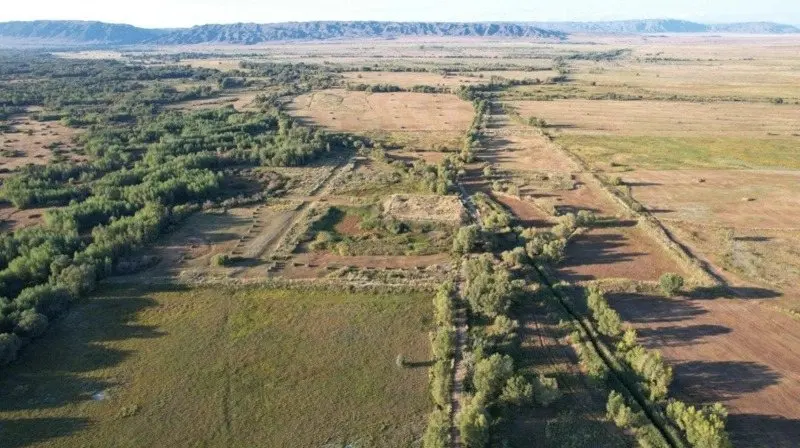
Archaeologists from Al-Farabi Kazakh National University have unearthed a substantial settlement from the Turkic Khaganate era in East Kazakhstan, and it's one of the more intriguing recent finds on the old Silk Road fringe. The site, known as Kalzhyr, sits between the villages of Kalzhyr and Boran in the Zaysan Basin and spreads across more than 25 hectares — a genuinely large complex, not a scattered scatter of potsherds.
Excavations focused on the southern fortifications of the fortress, where the team found the main defensive structures had been heavily damaged by fire. Inside, though, the preservation is remarkable: earthen floors survive, along with plaster still bearing traces of ornament, and fragments of reed-and-clay building work. Radiocarbon dating puts the settlement in the 6th–7th centuries AD, meaning it was likely built during the First Turkic Khaganate — the vast nomadic empire that at its height stretched from Mongolia to the Black Sea.
The everyday finds are just as telling as the walls. Archaeologists recovered charred wheat and legume grains, evidence of farming in a region better known for its steppe-riding heritage, plus ceramic vessels and one standout artefact: a rare ceramic bird figurine with a rattle inside, possibly a toy or ritual object.
There's an older story here too. The expedition identified a kereksur — a burial structure from the Late Bronze Age — at the site. That matters because these monuments are mostly known from Xinjiang and Mongolia, and this find pushes their known western boundary further than before. Expedition leader Nikita Konstantinov said the data will feed into digital models and a geographic information system for the whole region.
The project, titled "Archaeological Landscapes of the Zaysan Basin: Chronology, Spatial Analysis and Economic Systems," is funded by the Science Committee of the Ministry of Science and Higher Education. Teams from the D. Serikbayev East Kazakhstan Technical University and the A. Kh. Margulan Institute of Archaeology joined KazNU staff and students, who trained in modern survey methods including aerial and thermal imaging.
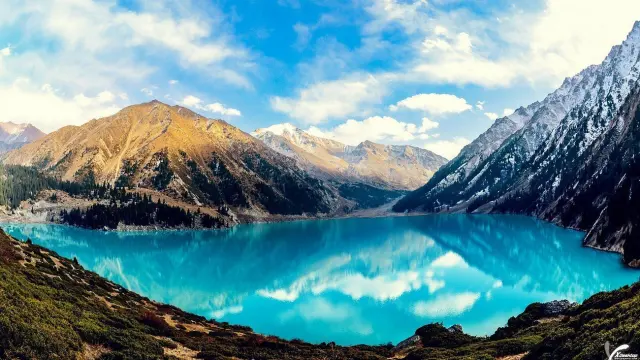
Why should a traveller care? East Kazakhstan remains one of the country's least-visited corners — a landscape of lakes, mountains and wide steppe around Lake Zaysan, near the Chinese border. Discoveries like Kalzhyr hint at the region's depth: this wasn't empty land between empires, but a settled, fortified place where people grew wheat and built ornamented homes 1,400 years ago. The site isn't developed for visitors yet, but the Zaysan Basin rewards independent travellers who want archaeology, history and big, empty scenery without the crowds of Charyn Canyon or Turkestan. Watch this space — as Kazakhstan invests in its archaeological tourism, places like this are likely to appear on itineraries in the coming years.
Story via The Astana Times.