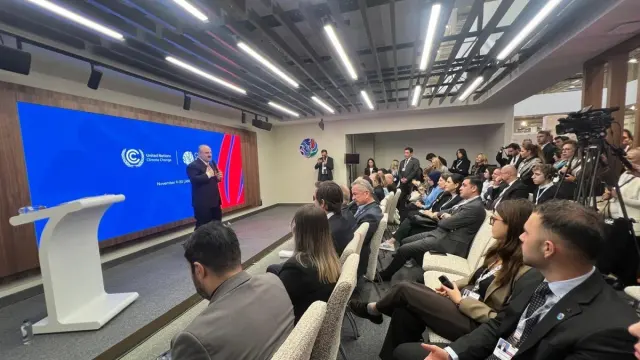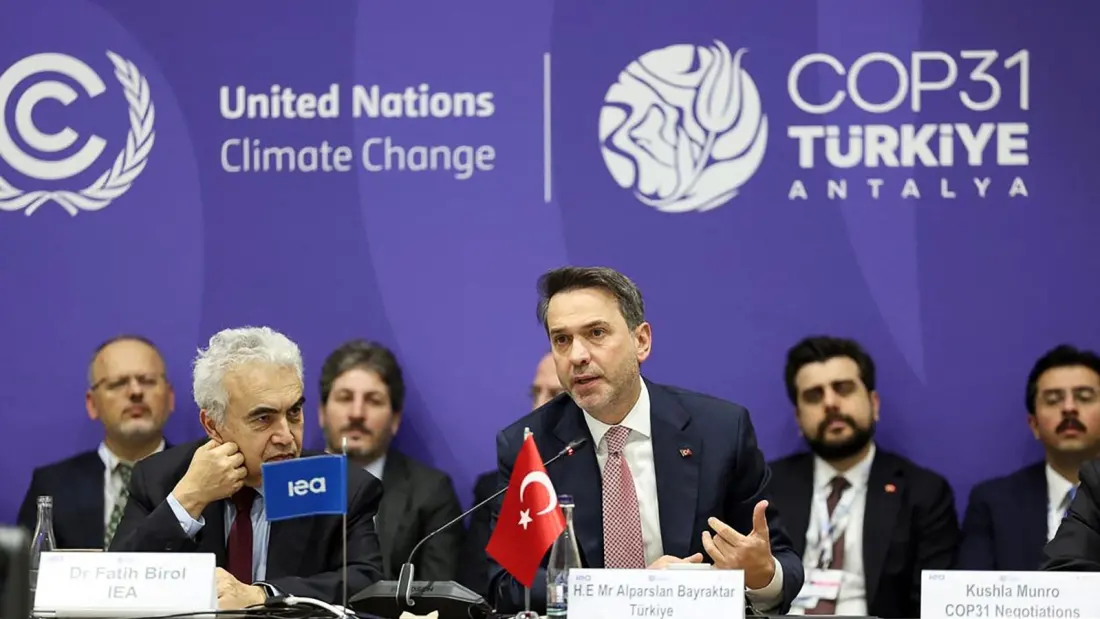
Hosting the U.N. climate summit in Antalya this week, Türkiye has used its moment in the spotlight to push a blunt argument: developing economies cannot simply switch off fossil fuels unless richer nations and lenders make clean energy affordable.
Energy and Natural Resources Minister Alparslan Bayraktar made the case in an interview with AFP on the sidelines of COP31 in the Mediterranean resort city. Technology and cheap financing are the deciding factors, he said — telling countries to stop burning coal and oil without offering those tools "doesn't make any sense". He pointed to nuclear power as a prime example: building plants requires enormous capital, and international financial institutions remain reluctant to back it.
The minister's comments sit alongside a slightly awkward reality. Even as Türkiye grows its renewable and nuclear capacity to cut its heavy dependence on imported energy, it has been doubling down on domestic hydrocarbons. President Recep Tayyip Erdoğan announced a new onshore oil discovery earlier this week, exploration is ramping up in the Black Sea and the country's south, and Ankara has signed energy cooperation deals with Venezuela — Bayraktar met its oil minister during the summit — as well as Somalia, Libya and Iraq. The goal, he says, is self-sufficiency: Türkiye currently needs around 700,000 barrels of oil and 57 billion cubic metres of gas, and would rather produce more of that itself.
Bayraktar insists none of this conflicts with the country's climate targets — carbon neutrality by 2053 and cutting oil consumption by 500,000 barrels a day by 2040. He also framed the issue as a matter of fairness, saying the "right of development" of all countries deserves respect. And he took a swipe at absent European leaders, singling out French President Emmanuel Macron, a high-profile climate advocate, for skipping the summit.
For travellers, why does any of this matter? Antalya, better known for its beaches and all-inclusive resorts than diplomatic summits, is having a busy conference season, and the security measures and demand that come with COP31 can affect hotel availability and transport in the city. Longer term, Türkiye's energy pivot shapes the places visitors see: new wind and solar farms across Anatolia, the country's first nuclear plant under construction at Akkuyu on the Mediterranean coast, and growing energy infrastructure along the Black Sea. A country that meets its 2053 carbon target will look and sound different to visit — quieter roads, cleaner air in cities like Ankara and Istanbul, and a bigger share of renewables powering those coastal hotels.
The bigger takeaway is a familiar one at climate summits: the gap between what developing economies are asked to do and what they're resourced to do. Türkiye, straddling both worlds as a NATO member, G20 economy and energy importer, is making itself the loudest voice for that argument this fortnight.
Reported by Daily Sabah Travel.