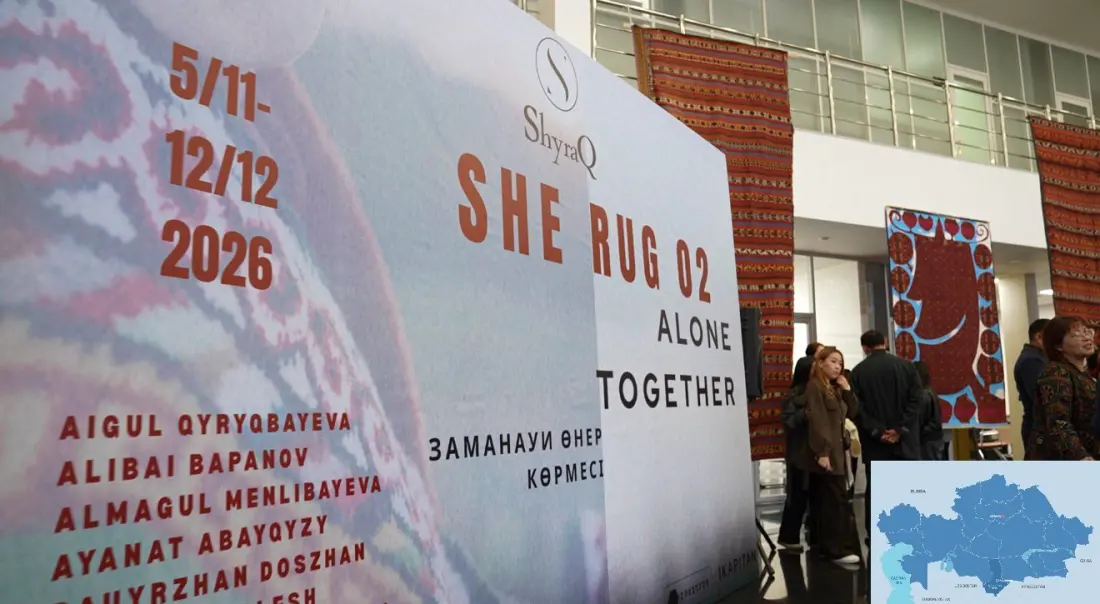
A car dealership is probably the last place you'd expect to find some of Central Asia's most compelling contemporary textile art. Yet in Shymkent, Kazakhstan's southern hub, the second edition of the SHE RUG exhibition has filled the Orbis Auto/Zeekr space on Tamerlan Highway with woven carpets, paintings and video works — a deliberate choice by the dealer to let locals encounter art somewhere unexpected.
SHE RUG 02, titled Alone Together, opened on November 5 and runs through December 12. The project began two years ago in Astana, where founder Sandugash Beisenbekova displayed a woven recreation of the Pazyryk carpet — one of the world's oldest known rugs, usually held in the Hermitage in St. Petersburg — to argue that Kazakh carpet weaving stretches back to the Saka civilization rather than being a 20th-century invention. This time the focus has shifted: less about origins, more about what carpets once held together in nomadic life, when belonging was practised through open doors, shared meals and skills passed from grandmothers to granddaughters. The curatorial themes even stretch to artificial intelligence, alongside women's labour and rural livelihoods.
Shymkent makes sense as the second stop. ShyraQ, the social enterprise Beisenbekova founded in 2023 after a career as a banker at the European Bank for Reconstruction and Development, employs around 15 women weavers in the neighbouring Turkistan Region, supplying them with small looms so they can work from home. The show has, in effect, travelled back to where the craft is still made.
The line-up mixes returning artists — Natalia Karagoz, whose painting "Carpet Flowers" draws on Gagauz ornament, plus Alibai Bapanov, Botagoz Tolesh and Natalia Bazhenova — with bigger names: Almagul Menlibayeva, one of Central Asia's most recognised contemporary artists, and Seoul-based Ayanat Abayqyzy. Rugs from five private collectors round out the display, with the Shymkent-based Ozbekali Zhanibekov University as academic partner.
There's a serious point underneath the art. Woven carpets can take a full year to make, which is why most Kazakhs know the quicker felt syrmak better. Beisenbekova's argument is economic as much as cultural: if traditional women's knowledge is properly valued, it can bring income and independence to village women with few other options. She hopes to take the project to the UK and France next.
For travellers, this is a rare chance to see living Kazakh craft treated as contemporary art rather than museum relic — and a good reason to add Shymkent to a southern Kazakhstan itinerary alongside Turkistan's UNESCO-listed mausoleum.