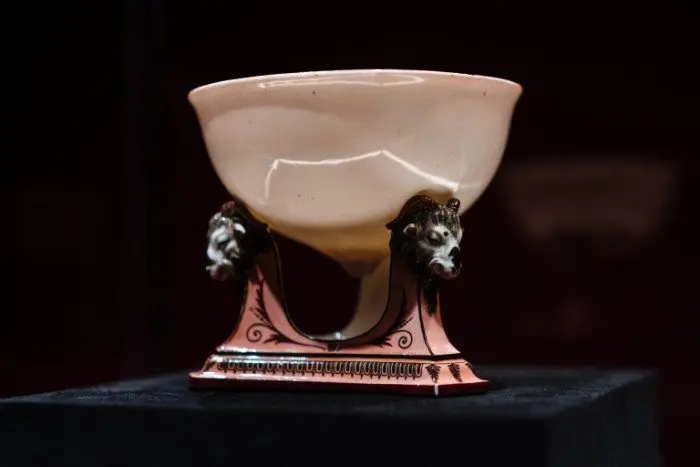
A late 18th-century porcelain bowl shaped like a woman's breast — pink nipple included — has sold for €2.9 million at Paris's Hôtel Drouot, setting a record price for Sèvres porcelain at auction. The saleroom had expected it to go for between one and two million, so the buyer, whose identity was not disclosed, paid well above the estimate.
The piece, known in French as a jatte-teton (literally "nipple bowl"), has a genuinely royal backstory. It was one of four commissioned by King Louis XVI for his wife Marie-Antoinette, intended for the dairy creamery at Rambouillet, a royal residence southwest of Paris. The Sèvres factory — still France's most storied porcelain maker today — produced the set in the late 1700s, and the bowl then vanished from view for roughly two centuries. It only resurfaced when it turned up in the inventory of the Meyer Gallery in Paris, a chance rediscovery that turned a forgotten storeroom item into a headline lot.
The provenance carries its own drama. Marie-Antoinette, the Austrian-born queen whose lavish spending helped turn French public opinion against the monarchy, went to the guillotine in October 1793 at just 37 years old. A cream jug or milk bowl from her household is therefore not just decorative china — it's a surviving fragment of the ancien régime's most famous excess.
There's a warmer note to the sale, too. Hôtel Drouot and the auction house Coutau-Bégarie, which ran the sale, agreed to donate part of the proceeds to Pink Ribbon, the breast cancer charity — a fitting gesture given the object's unmistakable shape.
So why should a traveller care? Because this story is a reminder of how much of France's royal history is still turning up, and how much of it you can actually visit. The Rambouillet dairy where the bowl was meant to be used still stands in the grounds of the Château de Rambouillet, an easy day trip from Paris and now open to visitors, complete with its eccentric marble-and-porcelain dairy rooms. Sèvres porcelain itself has a dedicated museum on the factory's original site just outside Paris, where you can trace the craft that produced this record-breaker. And Hôtel Drouot, the auction house that handled the sale, remains one of Paris's more under-the-radar cultural experiences — public auctions run daily and anyone can wander in and watch centuries-old objects change hands.
For collectors and art lovers, the headline figure matters: €2.9 million is a new benchmark for Sèvres under the hammer, which will ripple through valuations of French porcelain for years. For the rest of us, it's a quirky entry point into the world of Versailles-adjacent history — proof that a single oddball piece of china can carry the whole story of a doomed queen, a famous factory, and a royal pleasure grounds at Rambouillet that you can still walk through on a Saturday afternoon.