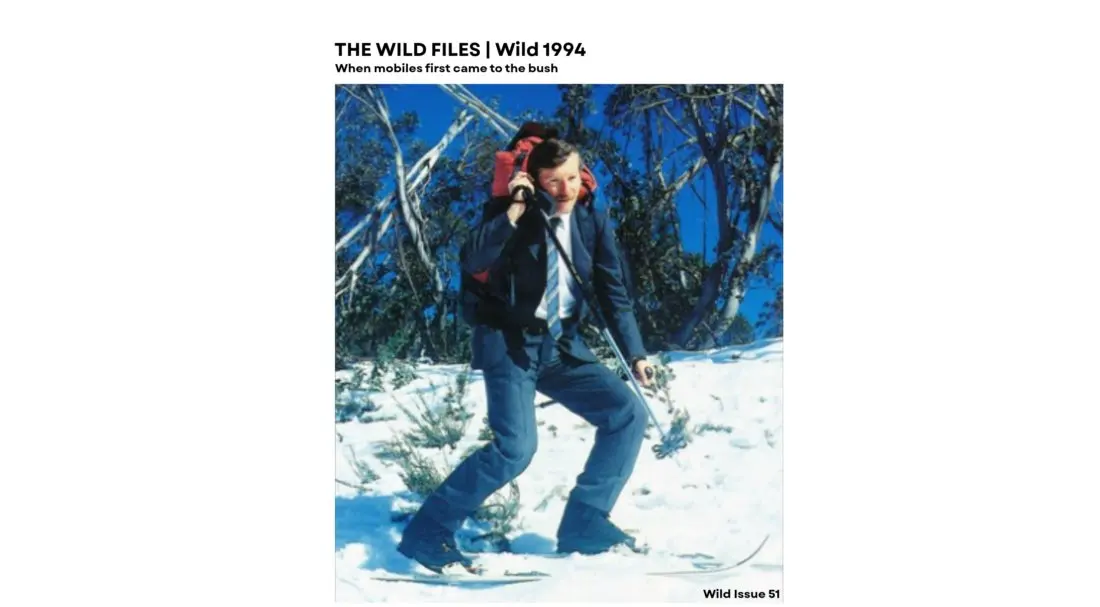
It's easy to forget there was a time when the backcountry was genuinely off the grid — no texts from a summit, no checking the forecast at camp. But the debate about phones in the wild isn't new. An archive piece from Wild magazine, first published in the summer 1994 issue (#51), shows Australian bushwalkers were already wrestling with exactly the arguments we have today about connectivity in the outdoors.
The writer's framing is charmingly dated: mobiles were for "yuppies" — young upwardly mobile types who might want share prices from the top of Mt Kosciuszko. But the serious point was safety. Back then, Australian mobile networks were entirely terrestrial: both the new digital system and the older analogue one needed line of sight to base stations that clustered around cities. Try to call from a gorge or an alpine valley and a mountain was in the way. Coverage in the NSW and Victorian high country was patchy at best. Satellite-based service, which Telecom expected "later this decade," was flagged as the real game-changer — the technology that would let you dial from virtually anywhere except a cave.
Even so, the author saw clear upside in carrying a phone. If someone snapped a femur cornice jumping, calling Police Search and Rescue directly could shave hours off a rescue. And a working phone could stop needless callouts: an overdue party could simply report that they were fine and walking out under their own steam. The counterargument, though, was equally clear. Phones might tempt people into trips beyond their skills, safe in the knowledge that a helicopter was a call away. The predicted cost of that complacency? A shift to "user pays" for emergency services.
The suggested etiquette holds up remarkably well. A trip leader could carry a phone the way they carry a first aid kit — packed, and only unpacked in an emergency. Nobody wants the person who produces a handset at every rest stop to check the football scores. If that bothers you, the article suggests, choose your walking companions more carefully.
Three decades later, the core advice sounds remarkably current: a phone is only ever a supplement to proper safety measures, never a substitute for navigation skills, planning and self-reliance. It's a fun piece of outdoors history — and a useful reminder for anyone heading into Australia's alpine country that coverage maps still have holes, even now. Anyone curious about how outdoor culture handled the arrival of the digital age will enjoy tracking down the original in Wild's print archive.