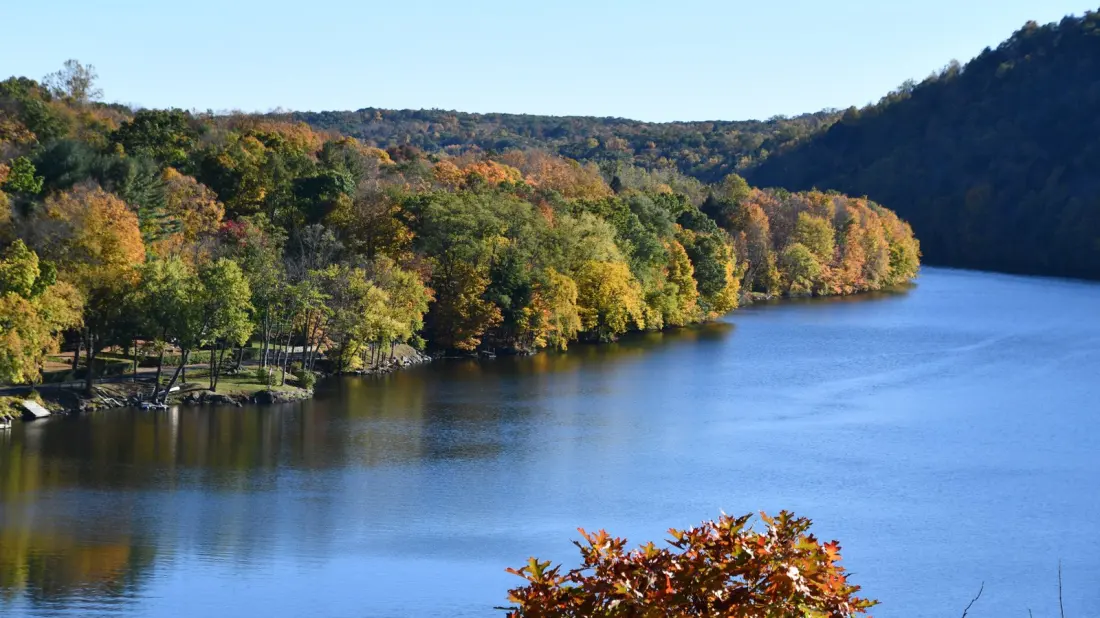
An hour from New Haven, in the wooded hills of southwestern Connecticut, sits a lake most out-of-towners have never heard of. Lake Lillinonah holds the state record for the deepest artificial inland lake at 110 feet, and it packs plenty into its 12 miles and 1,900 acres, which stretch across six towns including Newtown, Bridgewater and Southbury.
The lake only exists because of the Shepaug Dam, built on the Housatonic River in 1955 for flood control and hydroelectric power. What was left behind is now one of Connecticut's best spots for anglers: the Lake Lillinonah Authority rates it among the state's top fishing destinations, with strong populations of smallmouth and largemouth bass, lake trout, black crappies and northern pike. The state record pike — a 29-pounder landed in 1980 — still stands. Fishing runs year-round here, including ice fishing in winter, and bass tournaments fill the calendar from spring into early fall.
Boaters get a generous season too, roughly mid-May to mid-October. Two launches are free and open to everyone year-round: Lake Lillinonah Boat Launch in Bridgewater and Pond Brook Boat Launch in Newtown. The other two, at Lake Lillinonah Town Park and Eichler's Cove, need permits tied to town residency, with fees for outsiders. Speed limits cap daytime running at 45 mph, dropping to 25 overnight, and low traffic plus calm water make it a favourite for waterskiing and tubing. Note that swimming is off-limits at parts of the lake, including the town park. Anyone wanting coaching can book Connecticut Watersports in New Milford — the state's only all-ages watersports school — where an all-inclusive session for up to six people runs about $340 an hour.
The shoreline rewards landlubbers just as much. The 6.2-mile Lillinonah Trail loop in Paugussett State Forest takes around three hours, hugging the water in stretches (with some muddy patches), and pairs nicely with Sleeping Giant State Park if you fancy a leaf-peeping road trip in autumn. Come winter, roughly 40 bald eagles nest along the forested edges — locals sometimes call it "the eagle lake" — and Connecticut Watersports runs pontoon-based birdwatching tours that also look for blue herons, ospreys and cormorants.
There's no public transit, so plan to drive: New Haven is about 30 miles away and Hartford around 47, with New York City within day-trip range if you start early. Camping is banned at the lake itself, but Kettletown State Park nearby has public campgrounds, and towns like Southbury, Brookfield and New Milford offer inns — the Evergreen Inn Bed & Breakfast in Southbury, set in an 1818 estate, is 15 minutes from the water. If your idea of a getaway is a kayak at dawn, a rod in the afternoon and eagles overhead, this understated reservoir deserves a spot on your New England list.