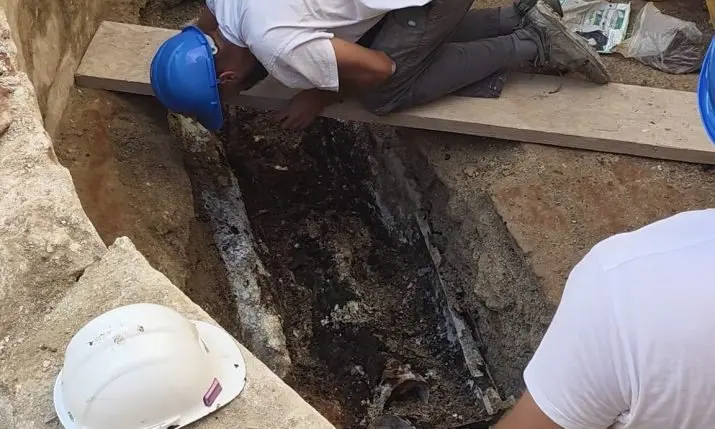
Work to repair Zagreb Cathedral, badly damaged in the March 2020 earthquake, has turned up a genuinely remarkable find. During excavations beside the cathedral's southern buttresses, archaeologists uncovered the long-lost Chapel of St John the Baptist — and beneath its floor, a sealed lead coffin holding skeletal remains now confirmed with 99% certainty to be those of Ivan Zakmardi, one of 17th-century Croatia's most important public figures.
Zakmardi (c.1600–1667) served as protonotary of the Kingdom of Croatia, but his lasting legacy is archival. In 1641 he was appointed to a commission collecting the kingdom's laws, privileges and official records, and two years later he compiled them into the Cista Privilegiorum Regni — the famous Chest of Privileges, secured with three keys held by the bishop, the ban and Zakmardi himself. That chest, kept first in the cathedral's sacristy, is now the founding collection of the Croatian State Archives. He also funded charities that educated disadvantaged children for nearly 150 years after his death.
The science behind the identification is striking. Anthropologists from the Croatian Academy of Sciences and Arts determined the remains belonged to a man over 65, matching Zakmardi's age at death in Banská Bystrica (in today's Slovakia) on 25 April 1667. Cuts to the skull and breastbone point to a post-mortem examination — required by sanitary rules of the era before a body could travel home to Croatia. There's no sign of a violent death. The lead coffin preserved the bones so well that researchers can even see green discolouration on the upper-body bones, likely from bronze threads in his burial clothing.
The grave goods paint a picture of high status: a wooden burial cross with bronze and gilded fittings, a rosary, a religious medal showing Ecce Homo and Mater Dolorosa, and leather shoes with silver buckles. Further CT scans, radiocarbon dating and textile analysis are under way, and the remains will eventually be reburied once conservation work is complete.
For travellers, the story adds another layer to a visit that most people already rank among Zagreb's highlights. The cathedral's ongoing restoration is itself a piece of living history — the earthquake damage is still visible from Kaptol square — and finds like this chapel show how much of medieval and early modern Zagreb still sits under the city's pavement. Even while scaffolding remains, the twin neo-Gothic spires dominate the skyline above the Upper Town, and the nearby Croatian State Archives holds the very chest Zakmardi filled nearly four centuries ago. If you're wandering Zagreb on foot, Kaptol, the Dolac market next door and the Museum of the City of Zagreb all sit within a few minutes' walk — and now you can stand there knowing one of Croatia's founding archivists has finally been found at home.