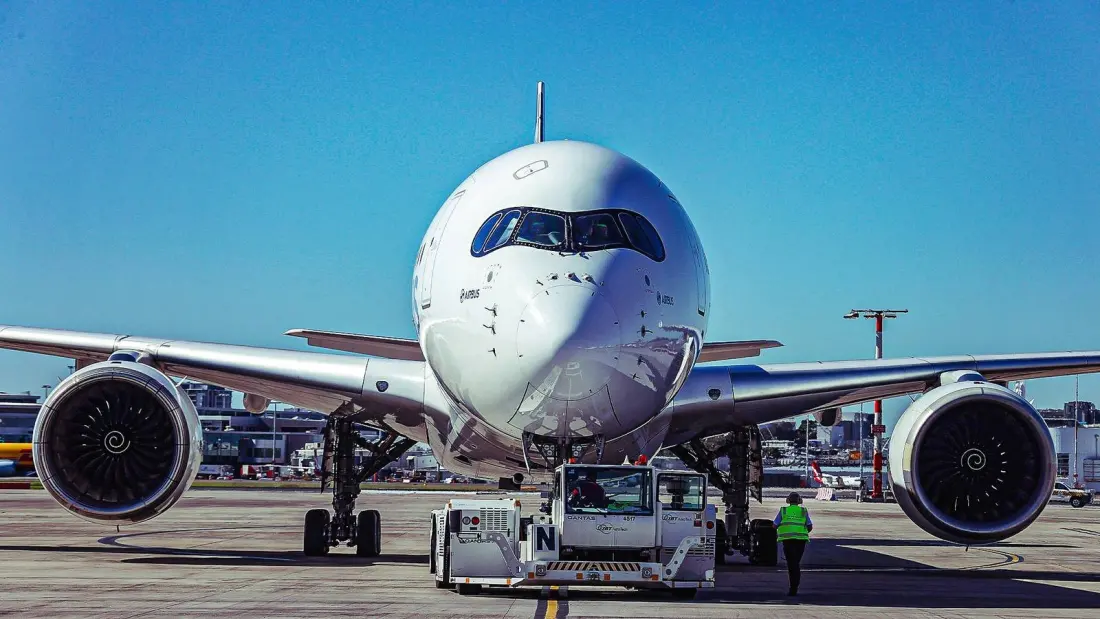
If you've booked a long-haul flight recently, chances are you've flown on an Airbus A350 without giving the suffix after the model number much thought. But the difference between the -900 and the -1000 is real — and it can change everything from how packed your cabin feels to how far nonstop your flight can go.
The A350 is Airbus's modern long-haul workhorse, built largely from carbon-fibre composites (around 70% of the airframe) and powered by Rolls-Royce Trent XWB engines. Since the smaller -900 entered service with Qatar Airways in 2015, more than 700 have been delivered, flying over two million flights and carrying some 530 million passengers without a single fatality.
So how different are the two main passenger versions? The stretched -1000 is roughly seven metres longer, which translates to space for around 40 to 50 extra seats. It's heavier too — maximum takeoff weight rises from about 280 to 308 tonnes — and it flies on a beefier engine, the Trent XWB-97, producing 97,000 pounds of thrust per side versus 87,000 on the -900. Wingspan and cabin height are identical, so both types use the same gates and give passengers the same wide, nine-abreast economy cabin with LED mood lighting and dimmable windows.
How airlines configure them is where it gets interesting. At one extreme, French Bee crams 411 passengers onto its A350-900s with a 3-4-3 economy layout, and its -1000s carry 480. At the other, Singapore Airlines flies some A350s with just 161 seats, nearly all business and premium economy. Same aircraft, wildly different experiences — so it's worth checking the seat map, not just the aircraft type, before you book.
Range is the other traveller-facing difference. The A350-1000 tops out around 9,000 nautical miles (16,670 km), the longest of any standard commercial widebody, while the -900 manages roughly 8,500 NM. Ultra-long-range variants go further still: Singapore Airlines uses the A350-900ULR for the New York–Singapore nonstop, and Qantas' 'Project Sunrise' flights from New York and London to Sydney are slated to launch on the A350-1000ULR in 2027.
Despite the -1000's extra seats and range, airlines have ordered the -900 far more heavily — 1,136 orders against 373, with 614 of the smaller variant already delivered. There's also chatter about a further-stretched A350-2000: Emirates president Tim Clark told Reuters his airline would 'certainly look at' such a version, which would pitch the A350 squarely against Boeing's upcoming 777X.
For holidaymakers, the practical takeaway is simple: if you're picking between two flights and one is on an A350-1000, you're likely getting a newer, roomier aircraft on a longer nonstop route — but check the airline's layout, because configuration matters more than fuselage length.