South Carolina's Congaree National Park rarely tops anyone's national park bucket list, and it has even picked up unflattering labels as one of America's least impressive parks. That reputation says more about expectations than reality. What looks at first glance like a swampy forest 18 miles outside Columbia is actually the largest intact stretch of old-growth bottomland hardwood forest left in the southeastern United States — a rare ecosystem that logging and development have nearly wiped out elsewhere.
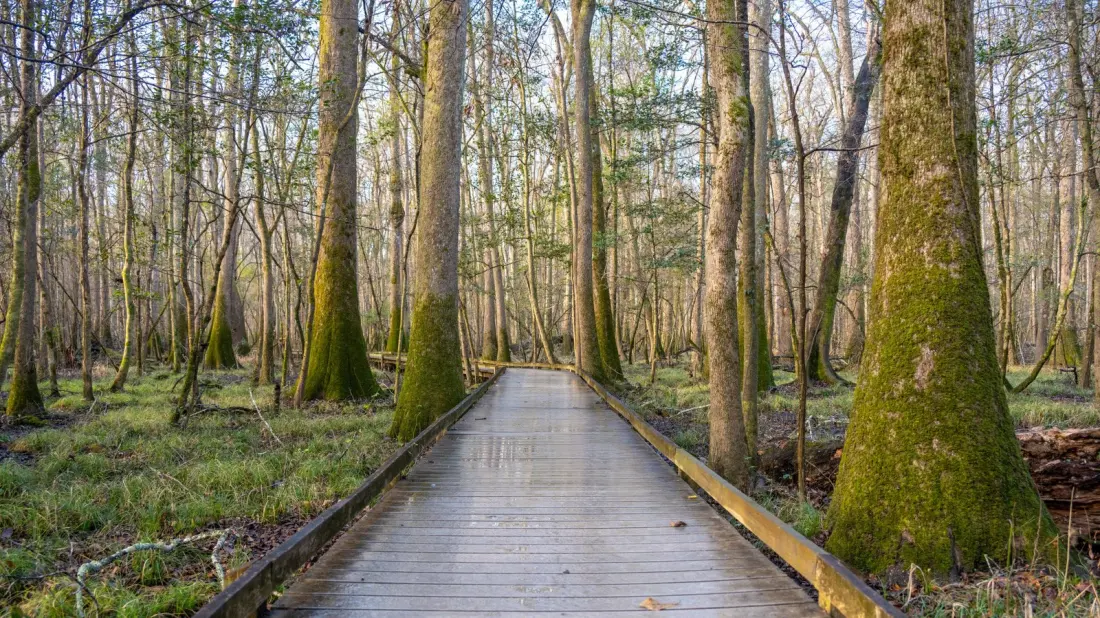
The easiest way in is the park's 2.6-mile Boardwalk Loop, which starts at the Harry Hampton Visitor Center. It exists for a good reason: Congaree's floodplain depends on regular flooding, which keeps the ground sodden and puts many dirt trails out of action. The elevated boardwalk solves that, floating visitors over the mud and straight into the forest. You walk beneath loblolly pines, bald cypress and water tupelo that together form the tallest tree canopy east of the Mississippi, along with several champion trees — the biggest recorded specimens of their species.
The loop splits into two moods. The upper section, nearer the visitor center, has wider planks and a more treetop feel, while the lower stretch drops close to the wetlands, winding past cypress trunks with water views. Both halves converge at the Weston Lake Overlook, an oxbow lake formed when the Congaree River changed course long ago — now a good spot to watch for turtles, snakes and the occasional alligator. Birdlife along the way is abundant. Most walkers finish the full loop in 30 minutes to an hour, and the surface is flat and even, making it one of the more accessible nature walks in the national park system.
Want more? The boardwork connects to longer routes: the 4.7-mile Weston Lake Loop and the 7.2-mile Oakridge Trail both branch off for a muddier, closer look at the forest. Birders with time to spare can tackle the backcountry Kingsnake Trail, often called some of the best birdwatching in South Carolina. Canoeing and kayaking the park's water trails are the other classic way to see Congaree.
For travellers, the appeal is practical as much as scenic: this is a genuinely world-class forest you can experience in a morning, with no permits, climbing or serious fitness required. Stop by the visitor center first for exhibits and self-guided tour brochures, then give yourself an hour on the loop before deciding whether to push further. If you've written off Congaree as a boring park, the boardwalk is the fix — it's a flat, easy stroll through trees you won't see anywhere else in the East.