
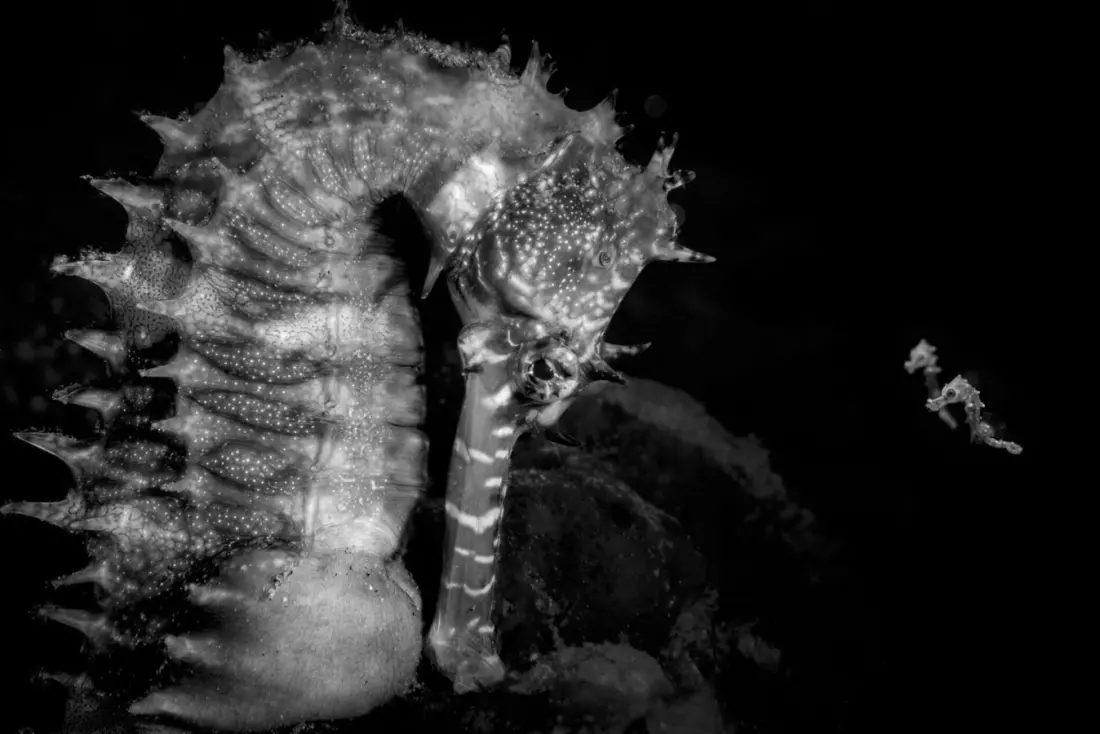
A black-and-white shot of three seahorses drifting in dark water off Moorea has won Frenchman Julien Anton the overall title at the 2026 Ocean Photographer of the Year competition. The image shows two tiny juvenile seahorses pausing beside a large adult male before swimming off — a moment Anton describes as feeling like the young looking back at their father before leaving home.
Anton is refreshingly candid about his status: he is not a professional. He and his team spent hours searching the seaweed-heavy waters around Moorea in French Polynesia with no guarantee of seeing a single seahorse, which is what made the payoff feel so extraordinary. The shot first won the Ocean Wildlife category before taking the overall crown.
The competition, run since 2020 by Oceanographic Magazine with support from watchmaker Blancpain, drew more than 15,000 entries this year across seven main categories plus portfolio and awards. A new category debuted in 2026 — The Ocean Unseen: Hidden Worlds — spotlighting the ocean's smallest, strangest residents. Its first winner is Japan's Mitsuna Kawai, who photographed an iridescent ribbonfish during a blackwater dive off Japan, the fish glowing ghostlike against the void.
Several winning images double as a destination inspiration board. Jenny Stock of the UK took the Female Fifty Fathoms Award — a peer-nominated honour for women in ocean photography started in 2021 — for an American crocodile gliding through Cuban mangroves. Australia's Matty Smith won the Fine Art category with a monochrome tawny nurse shark trailed by remoras in the Maldives, while Gergo Rugli captured dolphins surfing beside humans for over an hour at Tamarama Beach in Sydney.
The conservation categories carried the heaviest questions. James Ferrara's Conservation Impact winner shows a whale shark mobbed by divers and snorkellers in the Maldives — visually spectacular, but a pointed comment on wildlife tourism's pressure on a single animal. Thomas Pavy's Conservation Hope shot flips the script, showing scientists studying a great hammerhead in French Polynesia using laser-calibrated photogrammetry. Rui Duarte documented volunteers rescuing a stranded pilot whale in Boa Vista, Cape Verde, and Miguel Serrano Ruiz won the portfolio award for his work protecting olive ridley sea turtles in Mexico's Baja California.
For travellers, the takeaway is twofold. The winning locations — Moorea, Cuba's mangroves, the Maldives, Sydney's surf breaks, Cape Verde — map directly onto some of the world's best marine trips. And Ferrara's image is worth a pause before you book: crowded wildlife encounters may be photogenic, but choosing smaller-group, science-backed operators is what keeps encounters like these possible.
Credit: ExplorersWeb