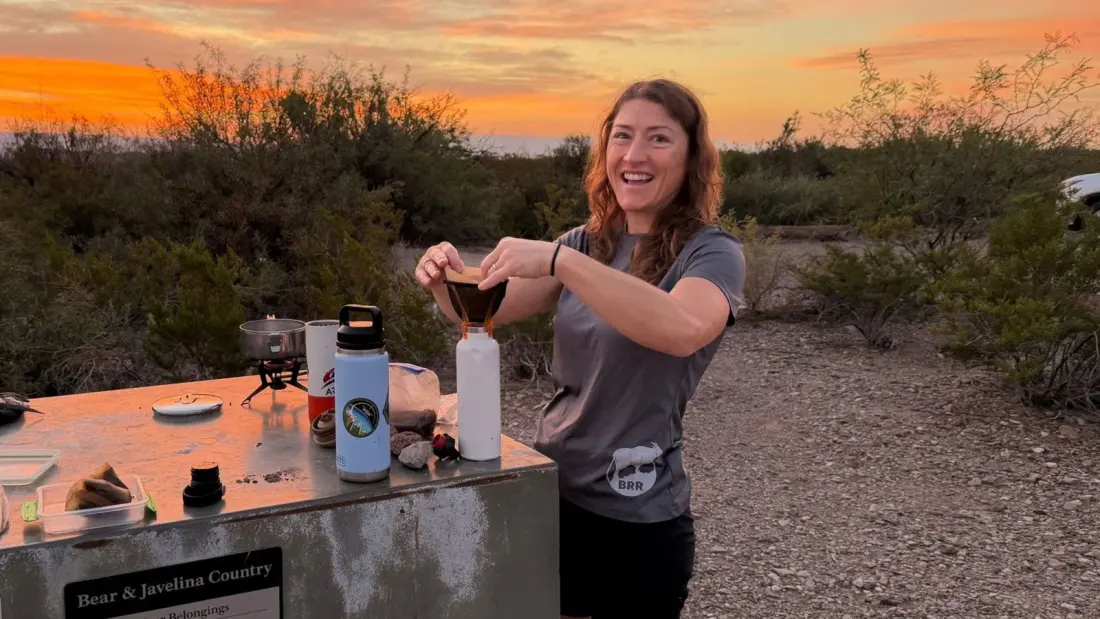
Five months after becoming the first woman to fly around the moon, NASA astronaut Christina Koch celebrated the way many of us would: a tent in the Chihuahuan Desert and a night of moon photography in Big Bend National Park. Outside Online joined her there in September 2026 for a hike up to Balanced Rock and an evening spent peering at lunar craters through a small telescope.
Koch, 47, made history on Artemis II, which launched from Kennedy Space Center on April 1, 2026, and completed a ten-day loop around the moon with commander Reid Wiseman, pilot Victor Glover and fellow mission specialist Jeremy Hansen. The crew travelled a record 252,757 miles from Earth, livestreaming the whole thing. Koch already holds the record for the longest spaceflight by a woman — 328 days across 2019 and 2020 — and took part in the first all-women spacewalk in October 2019. On this mission, the crew even named a lunar crater Carroll Crater, after Wiseman's late wife.
What makes the story appealing is how earthbound Koch remains. She cooked plain couscous on a backpacking stove at camp and talked about her years as a self-described dirtbag: climbing Mount Kenya in 2006 without porters (and running out of food mid-trip), working an eight-month Antarctic winter with no mail or fresh food at age 25, and doing fieldwork in Greenland, Alaska and American Samoa — where she met her husband via surf-report photos. She's also a climber, skier, surfer and a triathlete who took up swimming in her mid-forties, a few months after a hip replacement.
The Artemis II crew also trained differently from the Apollo generation. Beyond technical drills, they went on a National Outdoor Leadership School (NOLS) expedition to build trust, studied the moon's cultural meaning with experts, and worked with a poet to find better language for what they'd see — a practice Koch continues.
For travellers, the real hook is Big Bend itself. Koch's nighttime itinerary is easy to copy: hike a couple of miles to Balanced Rock, a huge boulder suspended between rock stacks, and shoot the stars and moonrise over the syenite formations. With dark skies and warm desert nights — mid-70s Fahrenheit even at 10 p.m. in late September — it's one of the best places in the US to appreciate what Koch points out to visitors: the Terminator, the shadow line that makes craters pop in 3D, visible even through a modest telescope.