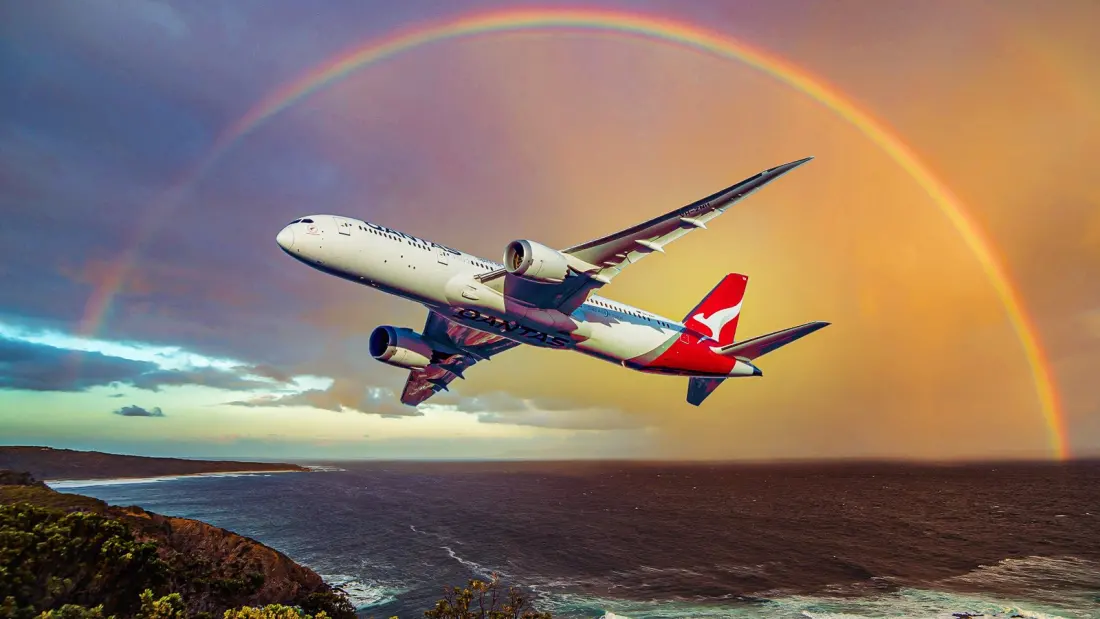
Australia sits a very long way from almost everywhere, and its airlines have answered with some of the most punishing commercial flights on the planet. As of 2026, seven ultra-long-haul sectors out of the country's international gateways stand out — and one brand-new route is about to join the club.
The newcomer is Qantas's Sydney–Las Vegas service, launching 29 December 2026 as the first direct Australia–Nevada link. Flight QF55 runs three times weekly through 12 March 2027 on a Boeing 787-9, taking roughly 13 hours 55 minutes eastbound and closer to 15 hours back. It skips the usual LA and San Francisco connections entirely and saves up to five hours for the 250,000-plus Australians who visit Vegas each year, with CES and the North American ski season driving the winter schedule.
Qantas dominates the list. Perth–Rome (16 hours 25 minutes westbound) is the airline's key continental Europe link, now daily through late October on two-class 787-9s — a valuable workaround while Middle East airspace closures complicate other Europe routings. Sydney–Dallas/Fort Worth is the carrier's only A380-operated North American route: a 485-seat double-decker flying up to 17 hours 5 minutes westbound. Melbourne–Dallas is its longest active transpacific route at 8,990 miles, three times weekly on a 787-9 with a 17-hour 35-minute return leg. And Perth–London Heathrow remains the flagship — the modern Kangaroo Route at 9,010 miles and up to 17 hours 50 minutes, though the outbound leg currently makes a technical refuelling stop in Singapore because of Middle East airspace restrictions. The return still flies non-stop in under 16 hours 30 minutes.
Two American carriers round out the seven. American Airlines' seasonal Brisbane–Dallas service is the longest flight in its entire network at 8,299 miles, with a 16-hour 50-minute westbound block time and a quick hop onwards to more than 200 destinations from its Texas megahub. United's Sydney–Houston route, at 8,596 miles, is United's longest flight anywhere — 17 hours 30 minutes westbound on a 787-9 with 48 Polaris suites, hooking Sydney into a Gulf Coast hub popular with energy-sector travellers and offering connections across the Americas.
What makes all this possible is the 787-9's composite airframe and efficient GEnx engines, which let twinjets carry full payloads across 8,000-plus miles of ocean. The next step is Qantas's Project Sunrise: purpose-built Airbus A350-1000ULRs will eventually fly Sydney–London and Sydney–New York non-stop, leapfrogging everything on this list.
For travellers, the practical takeaway is simple: from Australia's major cities you can now reach Texas, Nevada, London or Rome without changing planes — provided you're willing to settle in for the better part of a day in the air. Pick your cabin accordingly.
Simple Flying