Belitung, a boot-shaped island off Sumatra's east coast, has spent years flying under the radar. That's changing. The island earned UNESCO Global Geopark status, a direct flight from Singapore has launched, and two eco-minded hotels now sit on its shores — all while locals try to turn the spotlight into a model for sustainable tourism rather than a mass-tourism free-for-all.
The geopark designation protects 17 geosites, and one of the most atmospheric is Bukit Peramun, a 60-hectare community-managed forest a half-hour inland. Guides now escort every visitor through ironwood and wild fig forest, pointing out traditional remedies and curiosities like the Batu Kember, or Twin Rocks — teenagers from five surrounding villages once had to touch both rocks at once with outstretched arms to prove they were ready for marriage. At sunset, a pop-up terrace serves tea and cassava dipped in local honey, before rangers with infrared lights lead visitors quietly to spot the endangered Belitung tarsier, a tiny wide-eyed primate found almost nowhere else. Encounters are deliberately kept brief so the nocturnal animals can feed.
Along the coast, the 350-hectare Tanjung Kelayang Reserve hosts two new properties built with a light footprint. The Sheraton Belitung uses handmade clay bricks, local renggadai wood, solar power and rainwater, with kaolin-lined ecoponds instead of manicured lawns. Further along, the Billiton Ekobeach Retreat offers villas of dolken logs topped with nipa palm roofs.
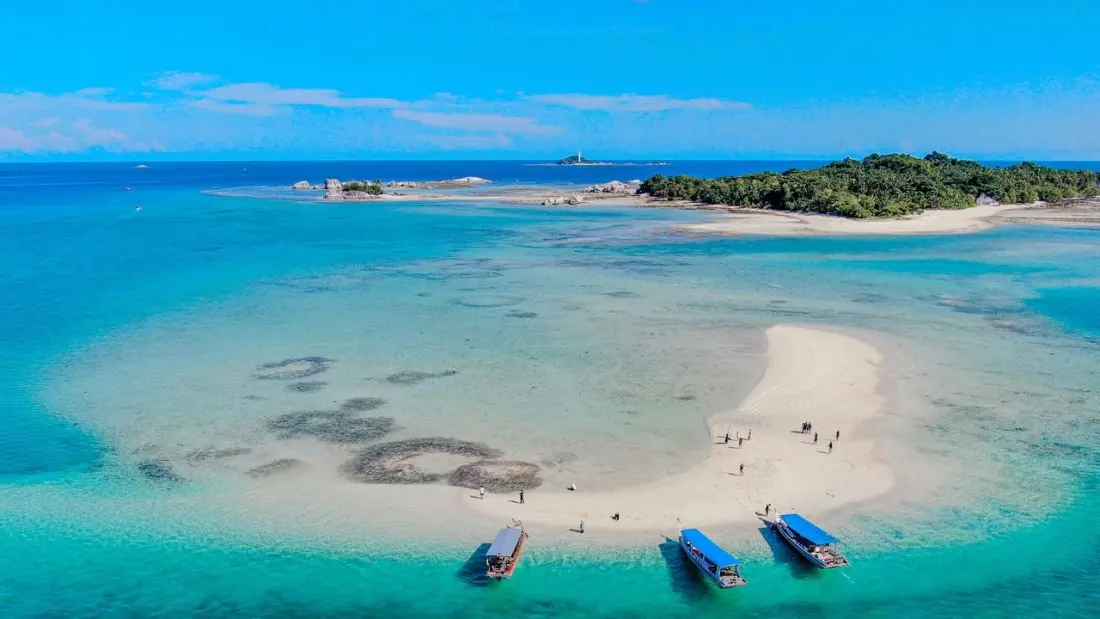
The water is the real draw. Outfitters like Blue Mind Experience run boat trips between islands where granite boulders stack like sails — the reason Belitung gets tagged the "Maldives of Indonesia" — and anchor at sandbars dotted with pink starfish. There's a 19th-century Dutch lighthouse on Lengkuas Island, caves with roosting bats on Kelayang, and reefs with clownfish and parrotfish in improbably good condition. Local divers still hunt for sea cucumbers between the islands — and occasionally 9th-century Tang dynasty treasure, like the hoard found offshore in 1998.
Belitung's other claim to geological fame is the Satam stone, a rare jet-black tektite thought to have formed when a meteorite hit the tin-rich land more than 700,000 years ago. The stones were once polished into lucky heirloom jewellery; they're now protected, so the community workshop BICA Ceramic makes replicas from local clay for visitors. Elsewhere, designer Bella Kartika Aprilia's batik label Sepiak Belitung employs more than 20 artisans and prints motifs of white pepper, fishing boats and tiered candle umbrellas onto resortwear.
Why go now? Because the geopark status, new flight route and hotel openings mean Belitung won't stay quiet much longer — but right now you can still have a beach, a forest trail or a sunset viewpoint largely to yourself, and your money supports guides, artisans and conservation projects rather than resort chains. It's built for travellers who'd rather slow down, meet people and learn the stories behind a place than tick off sights.