Boeing's 777X has been stuck in testing for years, but the aircraft now taking shape promises the biggest cabin overhaul the manufacturer has ever attempted. First deliveries are expected around 2027 — nearly a decade late, with Lufthansa as launch customer — and when the plane finally arrives, the passenger experience is set to change more than any of its efficiency figures suggest.
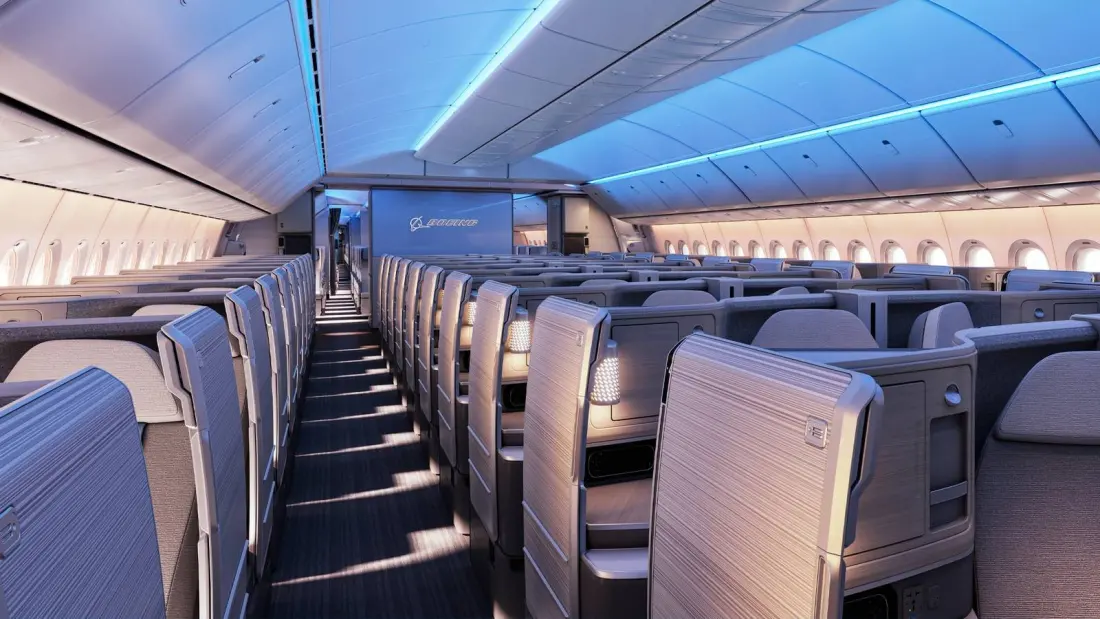
The headline change is space. The 777X cabin is four inches wider than the previous 777, measuring 19 feet 7 inches across, thanks to thinner wall materials and a shift from bulging to recessed surfaces on walls and overhead bins — the same sculpting trick that made the 787 Dreamliner feel so open. In economy, that translates to ten-abreast seating with 18-inch-wide seats and roomier aisles and sidewalls. First-class pods get three of the new extra-large windows each. Those windows are 17% bigger than the current 777's and 29% bigger than the Airbus A350's, and they can be dimmed electronically or shaded conventionally. The bins hold more luggage than they look, load from the side, and reportedly need about 40% less effort to close.
Comfort goes beyond geometry. Cabin pressure will be set to a 6,000-foot equivalent instead of the usual 8,000 feet, and humidity will run at roughly double the level of older Boeing jets — two Dreamliner features that reduce fatigue on long flights and may soften jet lag on arrival. Despite the GE9X engines being the most powerful turbofans ever fitted to an airliner, the cabin — and the neighbourhoods around airports — should hear less noise, helped by engine design, better insulation and quieter air conditioning.
For airlines, the cabin is deliberately modular: galleys, lavatories, crew bunks and seating can be reconfigured without heavy modification, with first class in four- or six-abreast suites and business class in seven- or eight-abreast layouts. Combined with a claimed 10% operating-cost advantage over the A350 and the fuel savings from folding wingtips and composite construction, that gives carriers like Emirates, Qatar Airways and United — all big 777 operators — both the incentive and the flexibility to build premium products on top of it.
Why should a traveller care? Because the 777X will likely become the default aircraft on ultra-long routes — think Singapore to New York or London to Dubai — over the next decade. If Boeing delivers, you'll be flying in a quieter, more humid cabin at a lower pressure altitude, with wider economy seats and noticeably bigger windows. The catch is the schedule: certification is still ongoing, and Boeing's recent track record gives everyone reason to wait and see before booking around it. But if the aircraft matches its promise, the 777X could make the long-haul economy seat genuinely pleasant for the first time in a generation.
Via Simple Flying.