If you're counting down to a ski trip, your pre-season gym routine probably includes squats, lunges and maybe some hamstring work. What it's probably missing, according to a doctor who looks after the U.S. women's ski team, is training for the gluteus medius — the small muscle on the outer hip that plays an outsized role in keeping knees intact on the slopes.
Dr. Gregory Lichtman, an orthopedic surgeon in northern California, explains that ACL tears are among the most common ski injuries, and a weak glute medius is part of the problem. The muscle fires when you lift your leg out to the side and, crucially, stops the knee from caving inward — a position called valgus. When a skier drifts into the "back seat" (weight shifted behind the skis) and the knee collapses into valgus, the tibia can rotate internally, and that's precisely where ACL tears happen. Even without a full tear, repeated valgus can cause patellofemoral pain, that nagging ache at the front of the kneecap.
Here's the catch: unlike quads or hamstrings, which get plenty of work from running and hill climbing, the glute medius rarely strengthens itself. Even serious athletes often have a weak one, Lichtman says, so it needs deliberate, targeted training.
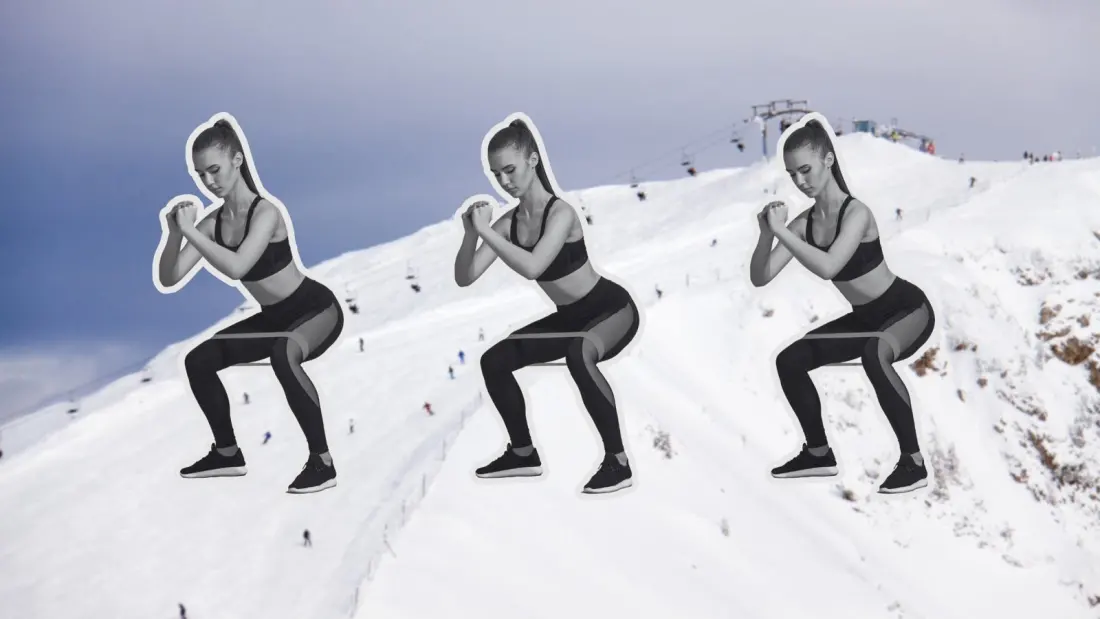
His preferred exercise is the monster walk. Rather than isolating the muscle with side-lying leg raises, this move recruits the glute medius alongside the core, quads, hamstrings and glute max — closer to how the body actually works during sport. The setup: loop a resistance band just above your knees, sink into a slight bend (around 45 degrees), brace your core, then step sideways, following with the other leg while keeping constant band tension. Do five to ten reps in one direction, repeat the other way, and keep going until the muscles give out — Lichtman's phrase is "go till you blow." Rest, then complete three sets, three days a week with a rest day between sessions. Vary the direction — forward, back, diagonal — to hit different parts of the hip, and upgrade to a stiffer band once it feels easy.
Timing matters too. Many skiers train hard pre-season, then let dryland work slide once the lifts start spinning. If you're only skiing two or three days a week, continuing hip and core training through the season matters, because those are the muscles skiing itself doesn't fully work. The glute medius isn't a silver bullet, though: strong quads, a solid core and good endurance are what keep you out of the back seat in the first place, and fatigue is a known risk factor for ACL tears. Lichtman's benchmark — being as fresh after lunch as after breakfast — is a useful gauge for how well your conditioning is holding up.
There's a performance payoff as well: a strong glute medius helps you commit your weight to the downhill ski and hold a firmer edge through aggressive turns, resisting the G-forces trying to throw you down the mountain. For anyone heading on a winter ski holiday, a resistance band and a few 15-minute sessions a week are a cheap insurance policy for the trip.
Story via Outside Online.