Kinshasa is famously intense — chaotic traffic, relentless noise, a city that doesn't ease anyone in gently. But tucked in the riverside Gombe district, in front of the Palais de la Nation, sits a monument that feels like it belongs to another ideological universe: the Mausoleum of Laurent-Désiré Kabila, one of the more surreal memorials on the continent.
Kabila's story is as dramatic as his tomb. Born in 1939 in Likasi, Katanga, he cut his teeth in Congolese politics around independence in 1960 as a supporter of Patrice Lumumba, later founding his own Marxist revolutionary party. In 1965 he even played host to Che Guevara, who arrived with Cuban fighters to back the struggle against Mobutu — an experiment Che remembered sourly, describing his host as charismatic but lazy and fond of drink. Three decades later, though, Kabila had the last laugh: leading the AFDL rebellion with Rwandan and Ugandan backing, he toppled Mobutu's Zaire regime in May 1997 and became president. His tenure ended on 16 January 2001, when one of his own bodyguards assassinated him. His son Joseph then ruled until 2019, making the Kabilas one of Africa's defining political dynasties.
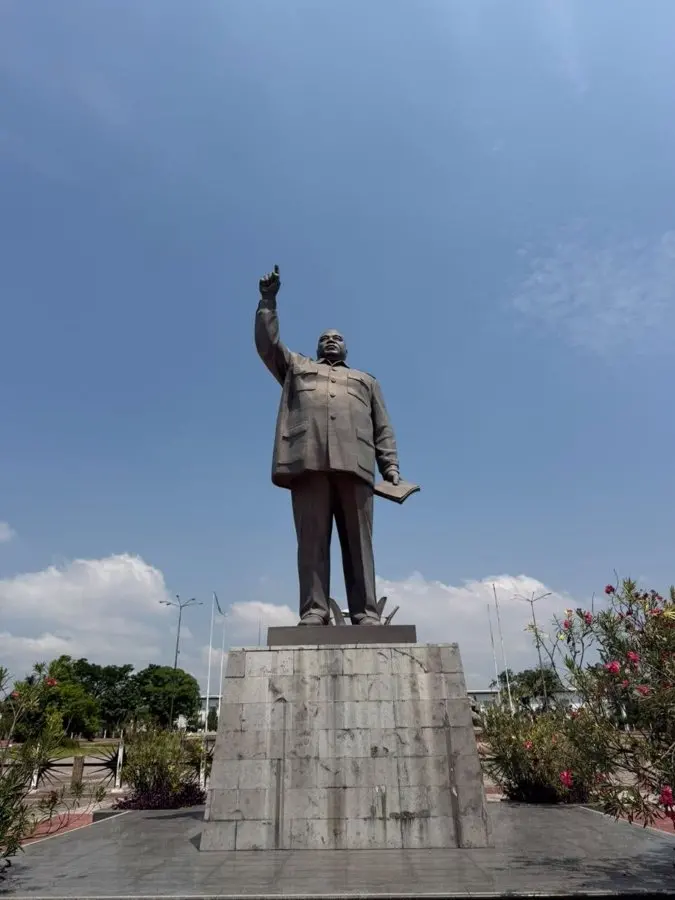
The mausoleum, completed in 2002, is designed by Congolese sculptor Christophe Meko and piles up symbolism with real enthusiasm. Outside stands an enormous bronze Kabila with a finger pointed skyward — a statue manufactured in North Korea, whose workshops have long specialised in monumental socialist bronzes. The tomb itself takes the form of a giant concrete tent, a nod to his guerrilla years, resting on a star-shaped marble platform held up by five sculpted fists bursting from broken shackles, each standing for the liberation struggle. Star motifs run throughout, echoing the original six-star Congolese flag that Kabila reinstated after Mobutu's fall — a flag representing the six provinces of 1960, even though the country now has more than twenty.
Inside, Kabila's coffin sits behind glass draped in the national flag, flanked by a bronze lion and an oversized open book. The inscription reads "Ne jamais trahir le Congo" — never betray the Congo. Statues of a boy with a laurel branch and a girl holding a dove round out the peace-and-victory imagery. It's over-the-top, deliberately political, and genuinely fascinating.
For travellers, this is one of Kinshasa's rare calm and photogenic spots, and a must for anyone interested in dark tourism or Cold War-style iconography still standing in the present day. It also pairs naturally with the surrounding Gombe district's colonial-era architecture, a quieter pocket of an otherwise overwhelming city. Practical reality: visits usually require arranging things locally — photography and access can depend on guards — so go with a local guide, dress respectfully, and treat it as a working memorial rather than just a photo op. Kinshasa rewards travellers who prepare, and this mausoleum is one of its most rewarding oddities.
Credit: Young Pioneer Tours